

-
info@Metroprotective.ca
Send Email
-
Toronto – Hamilton – London – Windsor
Metro Protective Services
Tel: 416-240-0911
Confidentiality Guaranteed
Tel: 416-240-0911
Confidentiality Guaranteed
03
Sep
Sep
De-Escalation and Customer Service: The Human Standard for Professional Mall Security
Home > Blog > Mall Security > De-Escalation and Customer Service
Published: August 29, 2026
Category: Mall Security
Tags: Mall Security Toronto, Security Guard Services Toronto, Retail Loss Prevention, De-Escalation, Customer Service, Commercial Security, GTA Security
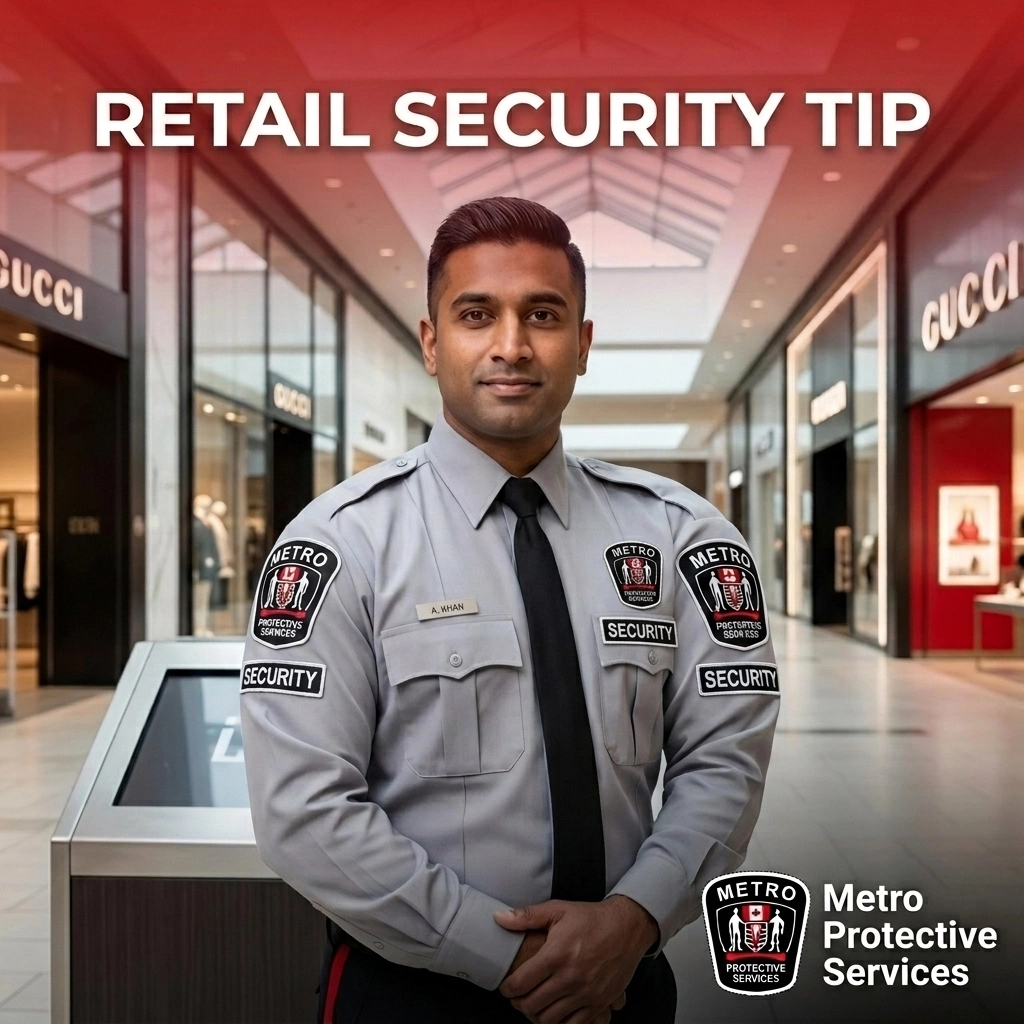
A shopping mall is more than a collection of retail stores. It is a busy public environment where shoppers, employees, tenants, contractors, families, seniors, and vulnerable visitors interact throughout the day. When concerns arise, the quality of the security response can influence not only immediate safety but also customer confidence, tenant satisfaction, and the property’s reputation.
Professional mall security must therefore combine vigilance with sound customer service. Guards need to identify risks, protect people and property, and enforce site policies while communicating respectfully. The objective is not to create unnecessary confrontation. It is to resolve concerns safely, fairly, and with a clear focus on observable behaviour.
For Toronto and GTA property managers, de-escalation is an essential part of a modern security program.
Why Customer Service Matters in Mall Security
A uniformed guard is often one of the first people a visitor approaches when they need assistance. Shoppers may ask for directions, report a missing child, request help locating a vehicle, or raise concerns about another visitor. Employees and tenants may require support with an aggressive customer, suspicious activity, access control, or an emergency.
A professional guard must be prepared to act as both a safety resource and a calm point of contact. This does not mean ignoring violations or avoiding enforcement. It means handling every interaction in a way that protects safety and reduces avoidable tension.
Strong customer service in a mall security setting helps to:
- Encourage shoppers and employees to report concerns early.
- Reduce confusion during incidents and emergencies.
- Support a welcoming environment for tenants and visitors.
- Improve cooperation when policies must be enforced.
- Protect the property from unnecessary escalation and reputational damage.
- Provide consistent treatment across different customer groups and situations.
Metro Protective Services has served Toronto and the GTA since 2000. Our approach combines professional security guard services, retail loss prevention support, mobile supervision, detailed reporting, and 24/7 dispatch coordination for commercial properties.

The Human Standard for Professional Conduct
Professional conduct begins before an incident occurs. Guards should remain visible, alert, well-groomed, and prepared to assist. A simple greeting or offer of help can establish a positive relationship before a difficult conversation is necessary.
When interacting with the public, mall security personnel should:
- Introduce themselves clearly. State their role and explain that they are available to help.
- Use a calm and respectful tone. A measured voice is less likely to add pressure to an already tense situation.
- Listen without unnecessary interruption. People are more likely to cooperate when they believe their concern has been heard.
- Use plain language. Avoid jargon, sarcasm, threats, and confusing explanations.
- Focus on facts and behaviour. Describe what has been observed instead of making assumptions about a person’s intentions, background, or condition.
- Maintain appropriate personal space. Guards should avoid looming, pointing, touching, or blocking a person’s exit unless immediate safety requires action.
- Know when to request support. A guard should not attempt to manage a potentially violent situation alone.
De-escalation guidance from the Cybersecurity and Infrastructure Security Agency emphasizes calm communication, active listening, personal space, empathy, and obtaining assistance when violence may occur. These principles are directly applicable to busy mall environments.
A Practical De-Escalation Process
A consistent process allows guards to respond confidently while avoiding unnecessary confrontation.
1. Assess the Environment
Before approaching, the guard should consider the location, crowd density, exits, nearby employees, possible weapons, and whether the person is alone or involved in a dispute. The guard should also determine whether another officer, supervisor, mall manager, or emergency service is required.
Safety remains the priority. If violence appears imminent, the appropriate response may be to create distance, move bystanders away, request backup, and contact emergency services according to site procedures.
2. Make a Professional Initial Contact
The first words matter. A guard might say:
“Good afternoon. My name is [name], and I am with mall security. I would like to understand what is happening and see how I can assist.”
This approach establishes the guard’s role without immediately adopting an accusatory tone.
3. Listen and Clarify
The guard should allow the person to explain the concern, then ask short and relevant questions. Useful phrases include:
- “Please help me understand what happened.”
- “What would you like us to address?”
- “Can you show me where the issue occurred?”
- “Let me confirm that I understood you correctly.”
The guard should acknowledge frustration without promising an outcome that cannot be delivered. For example:
“I can see that this situation has been frustrating. I will explain what we can do under the property’s policy.”
4. Set Clear and Behaviour-Based Boundaries
If the conduct is disruptive, the guard should identify the specific behaviour and explain the required next step.
Instead of saying, “You are causing trouble,” a guard can say:
“I want to help, but yelling at staff is not permitted. If we speak calmly, I can work with you on the next step.”
If someone is blocking an entrance, the guard should address the location and action:
“This entrance must remain clear for shoppers and emergency access. Please move to the designated waiting area.”
This approach avoids labels and keeps the interaction connected to an enforceable rule.
5. Offer Reasonable Options
Where site policy permits, options can help reduce conflict. A person may be offered the choice of speaking with a tenant manager, moving to a quieter location, leaving the area voluntarily, or waiting for a supervisor.
Options should be realistic and consistent with the mall’s procedures. Guards should not negotiate away safety requirements or make exceptions that create unequal treatment.
Handling Common Mall Incidents Without Profiling
Customer and Tenant Disputes
Disagreements may involve returns, service quality, parking, deliveries, noise, or allegations between shoppers and employees. Security personnel should not take sides or make decisions outside their authority.
The guard’s role is to separate the parties if necessary, reduce the audience, protect personal safety, and connect the matter with the appropriate tenant representative or mall manager. If threats or physical contact occur, the response should shift from customer service to incident management.
Loitering and Extended Occupancy
Loitering concerns should be handled through clearly communicated property policies, not assumptions about appearance, housing status, age, disability, or mental health. Guards should focus on observable conduct, restricted areas, operating hours, and behaviour that creates a safety or access concern.
A respectful approach may be:
“This area needs to remain clear during operating hours. You are welcome to use the public seating area, or I can direct you to another location.”
If a person is not violating policy or creating a safety issue, presence alone should not be treated as grounds for unnecessary intervention.
Suspected Theft
Retail loss prevention requires observation, documentation, and consistent procedures. A guard should rely on behaviour-based indicators and verified information rather than stereotypes or personal characteristics.
When a suspected theft is reported, guards should:
- Obtain clear information from authorized retail staff.
- Record observable facts, times, locations, descriptions, and actions.
- Avoid public accusations or unnecessary physical contact.
- Follow the client’s detention, evidence, and police-notification procedures.
- Request supervisory support when the situation is unclear or escalating.
- Protect the privacy and dignity of everyone involved.
The objective is to prevent loss while minimizing risk to shoppers, employees, tenants, and the property.
Disruptive or Aggressive Conduct
When a person is shouting, using threatening language, or disrupting operations, the guard should maintain distance, use a calm tone, and avoid matching the person’s volume. Moving bystanders away can reduce audience pressure and protect uninvolved visitors.
The guard may state:
“I want to resolve this safely. I need you to keep your hands visible and stop threatening staff. If that does not happen, I will need to request additional assistance.”
If the person displays a weapon, makes a credible threat, attempts physical violence, or cannot be safely engaged, the guard should disengage and follow emergency procedures.

Accessibility and Mental-Health-Aware Communication
Malls serve a diverse public. A professional response should account for accessibility needs without making medical assumptions or using diagnostic labels.
Good practice includes:
- Speaking clearly and allowing additional time for a response.
- Asking the person what assistance would be useful.
- Using written information or visual directions when appropriate.
- Avoiding contact with mobility aids, service animals, or personal belongings.
- Reducing crowding and unnecessary noise when possible.
- Addressing behaviour and safety concerns rather than speculating about a diagnosis.
- Involving a support person, interpreter, manager, or emergency resource when appropriate and permitted.
- Calling emergency services when there is an immediate risk of serious harm.
Mental-health-aware communication does not mean that unsafe behaviour is ignored. It means that guards use patience, clear boundaries, and proportionate responses while preserving safety and dignity.
Operational Support Behind the Guard
De-escalation is more effective when guards are supported by a well-organized security operation. Mall operators should establish clear procedures for:
- Radio communication and priority calls.
- Backup and supervisor response.
- Tenant notifications.
- Missing persons and vulnerable visitor incidents.
- Retail theft and evidence handling.
- Emergency service coordination.
- Incident documentation and management review.
- Accessibility and accommodation requests.
Metro Protective Services provides 24/7 dispatch coordination to support guards and clients when conditions change. Our security services can be structured around mall patrols, retail loss prevention, access control, tenant support, mobile supervision, and incident reporting. Our company experience includes work with shopping malls, retail establishments, commercial properties, and other high-traffic environments.
Mall Security De-Escalation Checklist
Property managers and operators can use the following checklist when reviewing their procedures:
- Are guards trained to listen, communicate calmly, and set respectful boundaries?
- Do written procedures distinguish between customer service concerns and immediate safety threats?
- Are interventions based on observable behaviour rather than profiling?
- Do guards know when to request a supervisor or emergency assistance?
- Are accessibility considerations included in site training?
- Are retail loss prevention procedures consistent across tenants?
- Are public areas, entrances, lobbies, and restricted zones clearly identified?
- Are incident reports detailed enough to support follow-up and trend analysis?
- Is 24/7 dispatch available when a situation requires additional resources?
- Does management review incidents to identify recurring locations, times, or causes?
Conclusion: Professionalism Is a Security Control
De-escalation and customer service are not separate from mall security. They are part of effective risk management. A guard who communicates clearly, listens carefully, recognizes vulnerability, and focuses on behaviour can often prevent a difficult situation from becoming a serious incident.
For mall operators in Toronto and the GTA, the right security partner should provide more than a visible presence. It should provide trained personnel, consistent procedures, reliable dispatch support, professional reporting, and a service standard that protects both people and property.
Metro Protective Services has delivered security solutions across the GTA since 2000. To discuss mall security, retail loss prevention, concierge-style visitor support, or a customized security plan, submit an inquiry or call 416-240-0911.
Need Help? Chat with us to discuss your property’s requirements.

Recent Posts
- Tactical Security Services for High-Risk GTA Properties
- Top-Rated Security Guard and Property Protection Services in Toronto and the GTA
- Comprehensive Security Guard and Property Protection Services in Toronto and the GTA
- How to Choose the Best Loss Prevention Services in Toronto
Category Tags: Mall Security Toronto · Security Guard Services Toronto · Retail Loss Prevention · De-Escalation · Customer Service · Commercial Security · GTA Security

