

-
info@Metroprotective.ca
Send Email
-
Toronto – Hamilton – London – Windsor
Metro Protective Services
Tel: 416-240-0911
Confidentiality Guaranteed
Tel: 416-240-0911
Confidentiality Guaranteed
24
Sep
Sep
Comprehensive Security Guard and Property Protection Services in Toronto and the GTA: Retail Loss Prevention Coverage That Protects Shoppers, Staff, and Store Margins
Metro Protective Services › Security Services › Retail Loss Prevention
Published: September 23, 2026
Category: Retail Loss Prevention and Commercial Property Protection
Tags: Security Guard Services Toronto, Retail Loss Prevention, Commercial Security, Organized Retail Crime, Shopping Centre Security, Mobile Patrol, Property Protection
Seasonal retail periods bring higher customer traffic, longer operating hours, increased deliveries, temporary staffing, and greater pressure on store teams. These conditions can create additional opportunities for theft, fraud, workplace incidents, after-hours intrusion, and parking-lot problems across stores, shopping centres, retail plazas, and mixed-use commercial properties.
A practical seasonal loss prevention plan must protect more than merchandise. It must support shopper safety, staff confidence, tenant coordination, operational continuity, and accurate reporting. Professional security guard services Toronto businesses can rely on should be planned around the specific layout, hours, merchandise profile, and incident history of each property.
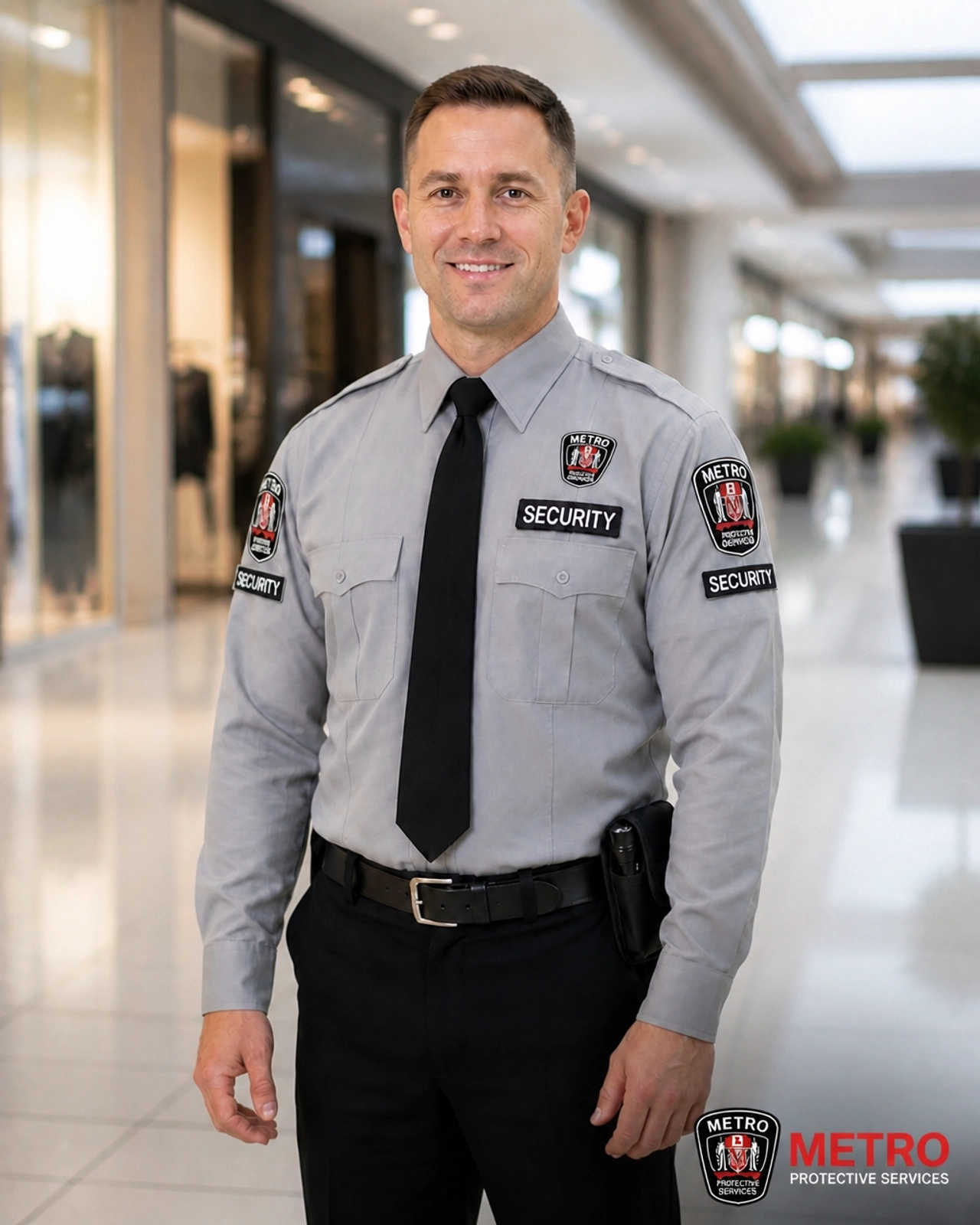
Metro Protective Services has served Toronto and the GTA since 2000. Our highly trained guards, 24/7 dispatch centre coordination, mobile patrol and parking enforcement capabilities, daily electronic reports, and competitive pricing help property managers and retail operators build a coordinated security program before seasonal risks increase.
Why seasonal retail security requires advance planning
Peak periods can change a property’s risk profile quickly. A store that normally operates with one entrance and a predictable customer flow may add temporary displays, additional registers, extended hours, seasonal workers, curbside pickup, and larger deliveries. Shopping centres may also experience heavier parking demand, crowded common areas, and more activity around loading zones.
A seasonal review should be completed several weeks before the expected peak. Property managers and retail operators should identify:
- Expected increases in customer traffic and operating hours
- High-value or frequently targeted merchandise
- Fitting-room, stockroom, receiving, and emergency-exit vulnerabilities
- Staffing levels during opening, closing, and delivery periods
- Parking and loading-zone concerns
- Existing camera, alarm, lighting, and access-control gaps
- Escalation contacts for tenants, property management, emergency services, and security supervisors
The objective is not simply to add a guard to a post. It is to position coverage where it can improve visibility, response, communication, and accountability.
Control entrances, exits, and fitting-room areas
Entrances and exits should remain visible, well-lit, and free from unnecessary obstructions. Seasonal promotional displays should not create blind spots or allow merchandise to be concealed near doors. Where appropriate, a professional security guard can provide a visible presence, monitor customer movement, support staff during busy periods, and communicate concerns to management without disrupting the customer experience.
Exit coverage should be based on store policy and applicable procedures. Guards should not make assumptions based on appearance, clothing, age, housing status, or other personal characteristics. Observations should be behaviour-based, documented objectively, and handled according to the client’s approved response plan.
Fitting rooms also require practical controls, particularly in apparel and department stores. Recommended measures include:
- Maintaining clear sightlines around fitting-room entrances
- Tracking the number of items entering and leaving when store policy permits
- Removing empty hangers promptly
- Assigning staff or security coverage during the busiest periods
- Reporting recurring patterns by time, department, or location
- Avoiding unnecessary congestion near fitting-room corridors
Security personnel should support staff rather than replace store procedures. The most effective approach combines professional observation, customer service, timely reporting, and safe escalation.

Recognize organized retail crime indicators without profiling
Organized retail crime can involve coordinated activity across multiple locations, rapid grab-and-run incidents, distraction techniques, fraudulent returns, or repeated targeting of specific high-value products. Indicators may include repeated visits connected to similar incidents, coordinated movement between individuals, unusual interest in specific merchandise, attempts to defeat security devices, or rapid departures toward a waiting vehicle.
These indicators should be assessed in context. A security program must never treat a person’s identity or personal circumstances as evidence of criminal behaviour. Guards should focus on observable actions, preserve relevant details, notify the appropriate contact, and follow the client’s escalation procedures.
For shopping centres and plazas, information sharing is especially important. A tenant may notice a pattern that is not immediately visible to property management or neighbouring businesses. Regular communication between tenants, landlords, mall management, and security supervisors can help identify repeat concerns while protecting privacy and maintaining professional standards.
The Retail Council of Canada’s security strategy resources also emphasize preparation, employee safety, incident response, and coordination with relevant partners.
Place high-value merchandise strategically
High-value, compact, or frequently targeted merchandise should be reviewed before seasonal displays are installed. Depending on the retail environment, appropriate controls may include:
- Moving premium products away from unstaffed exits
- Using locked fixtures, controlled displays, or electronic security devices
- Limiting the amount of high-value stock on the sales floor
- Keeping back-up inventory in an access-controlled stockroom
- Recording movement between receiving, storage, and sales-floor locations
- Assigning trained staff to high-value customer interactions
- Reviewing returns, refunds, voids, and inventory discrepancies
Merchandise placement should support both security and customer service. Overly restrictive controls can create unnecessary friction, while open displays in poorly monitored areas can increase exposure. A site-specific assessment helps determine where a guard, supervisor, or mobile patrol visit can provide the greatest value.
Protect staff through safe escalation procedures
Retail employees should know what to do when they observe suspected theft, threatening behaviour, a medical concern, or an escalating customer dispute. Staff safety must remain the priority. Merchandise is replaceable; employees and customers are not.
A seasonal response plan should define:
- Who staff should contact first.
- When a security guard or supervisor should attend.
- What information should be recorded.
- When 24/7 dispatch centre coordination is required.
- When emergency services should be contacted.
- Which situations require withdrawal and observation rather than intervention.
- How employees are supported after an incident.
Guards should be trained to communicate clearly, maintain professional boundaries, use de-escalation techniques, and follow lawful procedures. A visible, approachable presence can often resolve concerns before they become more serious, but staff and guards must have a clear process for requesting additional support.
Secure parking, loading zones, and after-hours periods
Commercial storefronts and plazas can remain vulnerable after the sales floor closes. Empty units, rear service corridors, loading docks, roof access points, garbage enclosures, and poorly lit parking areas may attract unauthorized activity or create safety concerns for closing employees.
Mobile patrol and parking enforcement can provide an additional layer across areas that a fixed guard cannot continuously observe. Patrol activity may include:
- Exterior checks of storefronts and vacant units
- Parking-lot and pedestrian-route observations
- Loading-dock and rear-door inspections
- Verification of doors, gates, and access points
- Support for opening and closing procedures
- Documentation of lighting, damage, suspicious activity, or unauthorized access
- Coordination with on-site guards, tenants, and property management
Metro’s marked patrol vehicles provide a visible deterrent, while scheduled coverage can be adjusted around delivery windows, closing times, incident trends, and tenant requirements.

After-hours checks should be supported by clear reporting. The Sky-Guard Monitoring System provides GPS check-in and electronic reporting, helping clients verify patrol activity and review site conditions through daily electronic reports.
Coordinate coverage across tenants and property teams
A shopping centre or mixed-use plaza is a shared operating environment. One tenant’s receiving area may connect to a common service corridor. A parking-lot issue may affect several businesses. A recurring incident at one storefront may also require a property-wide response.
Property managers should establish:
- A current tenant contact list
- A shared emergency and escalation procedure
- A standard incident-reporting format
- Rules for loading-zone and parking access
- Procedures for preserving video and other relevant information
- Regular security briefings during seasonal peaks
- A process for reviewing incidents without unnecessary disclosure of personal information
Other service lines may support this model. For example, concierge security services can assist with access control in mixed-use buildings, while residential security Toronto programs can help protect shared lobbies and residential entrances connected to commercial spaces. Construction site security services may also be relevant where active construction borders a retail plaza. These layers should be coordinated, but each should retain clear responsibilities.
Use reporting data to target coverage
Security coverage should be reviewed against actual conditions rather than applied uniformly. Daily electronic reports can help identify:
- Repeated incidents by time of day
- High-risk entrances or departments
- Recurring parking or loading-zone concerns
- Patterns involving opening, closing, or delivery periods
- Lighting, door, alarm, or camera problems
- Locations requiring additional patrols or temporary guard coverage
- The effectiveness of current escalation procedures
Managers can then adjust guard positioning, patrol schedules, fitting-room coverage, merchandise placement, or tenant communications. This approach makes security more accountable and can help control costs while maintaining effective protection.
Seasonal retail loss prevention checklist for property managers
Before peak operations begin, confirm that:
- A site walk-through has identified entrances, exits, fitting rooms, stockrooms, loading zones, and blind spots.
- High-value merchandise locations and control procedures have been reviewed.
- Store staff understand safe escalation and emergency contacts.
- Tenant, property management, and security contact lists are current.
- Parking-lot lighting, rear doors, gates, and loading areas have been inspected.
- Guard posts and mobile patrol schedules match traffic, delivery, and closing periods.
- Incident reports use consistent time, location, description, and action fields.
- The Sky-Guard Monitoring System is configured for GPS check-in and electronic reporting.
- Recent incidents have been reviewed to target coverage where it is most needed.
- A post-peak review date has been scheduled.
Need Help? Chat with us
Metro Protective Services provides professional security guard services for retailers, shopping centres, commercial landlords, plazas, and mixed-use properties throughout Toronto and the GTA.
Our team can help assess your seasonal requirements and recommend a practical combination of on-site guards, loss prevention coverage, 24/7 dispatch centre coordination, mobile patrol, parking enforcement, and electronic reporting.
Need Help? Chat with us
- Phone: 416-240-0911
- Email: info@metroprotective.ca
- WhatsApp: Start a conversation on WhatsApp
- Contact page: Submit an inquiry to Metro Protective Services
Since 2000, Metro has supported businesses and property managers with highly trained guards, 24/7 availability, modern reporting technology, and competitive pricing.
Recent Posts
- Looking for Better Commercial Security Services in the GTA? Here Are 10 Things You Should Know. September 23, 2026
- Toronto Security Guard Services 101: A Property Manager’s Guide to Mastering Real-Time Reporting, September 22, 2026
- Comprehensive Security Guard and Property Protection Services in Toronto and the GTA: Matching the Right Coverage to Construction, Retail, Concierge, and Mobile Patrol Needs, September 21, 2026
- Mobile Patrol Services in Toronto and the GTA: Extending Security Coverage Beyond the Guard Post, September 18, 2026

