

-
info@Metroprotective.ca
Send Email
-
Toronto – Hamilton – London – Windsor
Metro Protective Services
Tel: 416-240-0911
Confidentiality Guaranteed
Tel: 416-240-0911
Confidentiality Guaranteed
18
Sep
Sep
Mobile Patrol Services in Toronto and the GTA: Extending Security Coverage Beyond the Guard Post
Home > Blog > Security Services > Mobile Patrol
Published: September 18, 2026
Category: Mobile Patrol, Property Protection, Security Services
A security guard stationed at a lobby, gatehouse, or reception desk provides an important presence. However, a static post cannot continuously monitor every parking level, loading dock, perimeter gate, service corridor, or secondary building on a large property.
This is where mobile patrol services Toronto property managers rely on can extend coverage beyond the guard post. Scheduled and unscheduled patrols provide visible deterrence, physical inspections, alarm response, lock-up support, and documented oversight across properties throughout Toronto and the GTA.
Metro Protective Services has served businesses and property managers since 2000. Our trained officers, 24/7 dispatch centre coordination, mobile supervisors, competitive pricing, and Sky-Guard Monitoring System help clients maintain a more accountable and responsive security program.
What Mobile Patrol Adds to a Security Plan
Mobile patrol is a flexible service designed around the property, its operating hours, and its risk profile. A patrol officer may visit one site several times overnight or rotate through multiple locations within a property portfolio.
Typical patrol coverage can include:
- Parking garages and surface parking areas
- Loading docks and receiving zones
- Construction sites and equipment storage areas
- Retail plazas and commercial properties
- Industrial yards, warehouses, and utility facilities
- Residential complexes and condominium grounds
- Building perimeters, gates, fences, and vacant spaces
- Multiple properties managed by the same organization
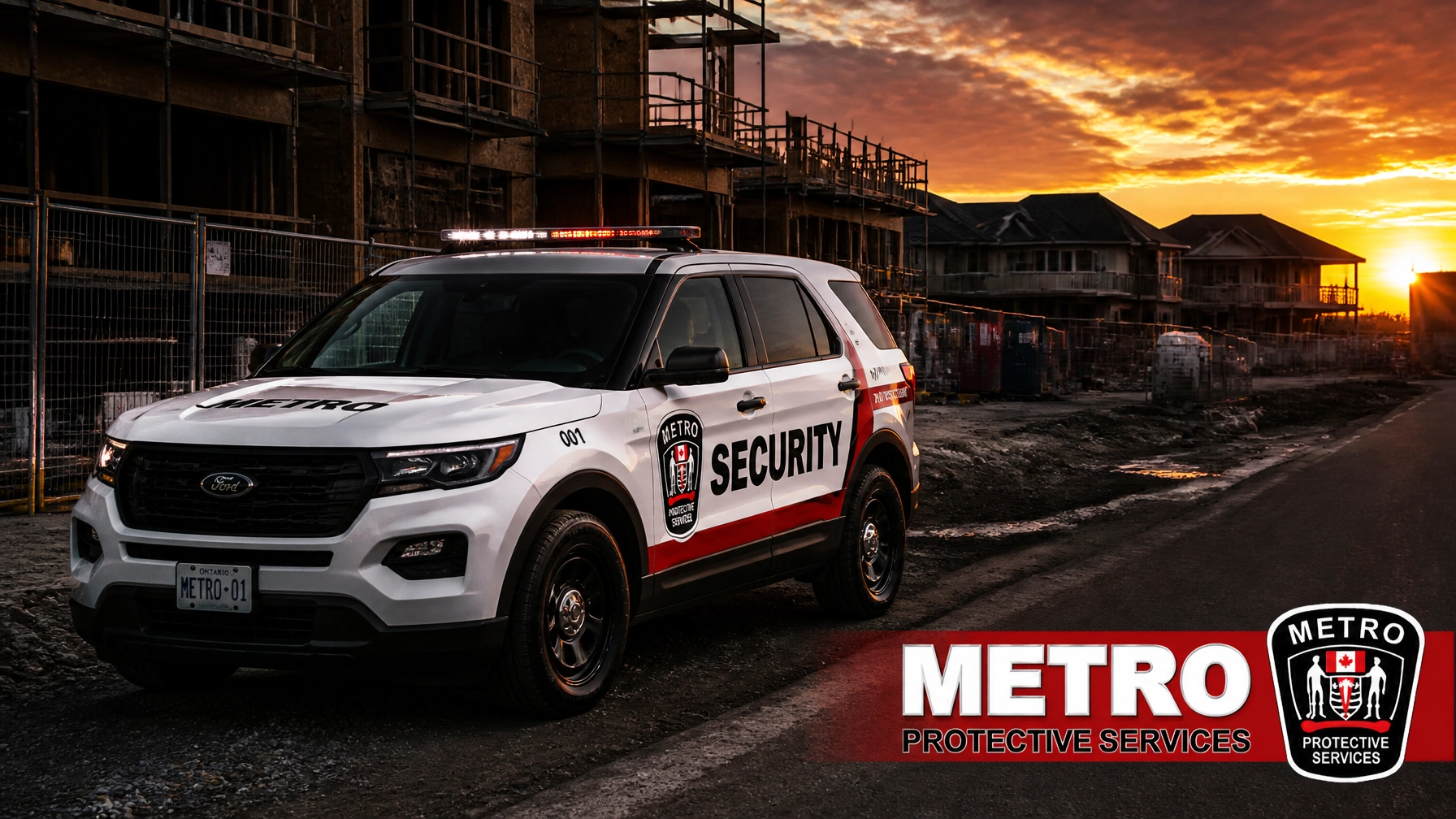
A marked patrol vehicle creates a visible deterrent, while the officer’s physical inspection identifies issues that cameras or a remote alarm may not reveal. These may include an unsecured door, damaged fencing, water leaks, suspicious activity, unauthorized persons, or a vehicle parked in a restricted area.
For organizations comparing security guard services Toronto providers, mobile patrol can complement a dedicated guard or provide practical after-hours coverage where a full-time static post is not required.

What Does a Mobile Patrol Officer Do During a Check?
A mobile patrol check is more than a drive past the property. Officers follow site-specific instructions and report their findings through the agreed communication process.
Depending on the assignment, a patrol may include the following steps:
-
Arrive and assess the immediate area
The officer observes the property from the vehicle before entering. They look for unusual vehicles, open gates, damaged barriers, people in restricted areas, or signs of forced entry. -
Inspect designated exterior points
Officers may check perimeter fencing, emergency exits, windows, doors, loading areas, mechanical entrances, storage zones, and other vulnerable locations. -
Conduct interior checks when authorized
Where access is provided, the officer may inspect lobbies, stairwells, parking levels, common areas, vacant units, corridors, or other designated areas. -
Confirm lock-up and access conditions
Patrol officers can assist with lock and unlock procedures, key management, alarm arming, and confirmation that doors or gates are secured. -
Respond to irregularities
If an officer finds damage, an open access point, unauthorized activity, or a safety concern, they follow the site’s escalation procedures. This may include contacting the property manager, notifying the 24/7 dispatch centre, requesting additional support, or contacting emergency services when necessary. -
Document the visit
Using the Sky-Guard Monitoring System, the officer completes a GPS check-in and submits an electronic report. Reports can include timestamps, observations, incident details, and photographs where appropriate.
This process gives property managers a clearer record of what was inspected and what conditions were observed during each visit.
Scheduled and Unscheduled Patrols Work Together
A strong mobile patrol program generally uses a combination of scheduled and unscheduled visits.
Scheduled Patrols
Scheduled patrols take place at predetermined times or within agreed time windows. They are useful for:
- Opening and closing procedures
- Lock-up and alarm activation
- Employee or contractor departure checks
- Regular parking garage inspections
- Construction site end-of-shift checks
- Required compliance or operational inspections
Scheduled visits create consistency and help ensure that specific duties are completed.
Unscheduled Patrols
Unscheduled or randomized patrols take place at variable times. They make it more difficult for trespassers, vandals, and other unauthorized individuals to predict when an officer will arrive.
Randomized visits are particularly useful for:
- Large industrial yards
- Retail plazas after closing
- Construction sites with valuable equipment
- Residential properties with recurring after-hours concerns
- Parking areas vulnerable to unauthorized use
- Multi-building portfolios requiring rotating coverage
The objective is not to create an arbitrary schedule. It is to establish reliable coverage without making the timing so predictable that the patrol becomes easy to avoid.
How Patrol Frequency Is Determined by Risk
There is no universal patrol frequency suitable for every Toronto or GTA property. The appropriate schedule should be based on a documented assessment of the location and its operating conditions.
Factors may include:
- Property size and layout
- Number of buildings or access points
- Existing lighting, cameras, fencing, and access controls
- History of theft, vandalism, trespassing, or property damage
- Value of equipment, inventory, vehicles, or materials on site
- Occupancy and operating hours
- Distance between buildings or separate properties
- Proximity to areas with increased after-hours activity
- Seasonal concerns, construction phases, or recent incidents
For residential properties, the plan may need to consider parking garages, entrances, amenity areas, delivery zones, and exterior walkways. In higher-risk areas, including locations near shelters, drug rehabilitation facilities, or supervised injection sites, a professional assessment should focus on documented incidents, access patterns, resident concerns, and site conditions: not assumptions about the surrounding community.
Mobile officers should be trained to use professional communication and de-escalation techniques. Their role is to observe, deter, document, and respond according to established procedures while treating residents, visitors, and members of the public respectfully.
Mobile Patrol and Static Security Should Complement Each Other
Mobile patrol does not always replace an on-site guard. In many cases, the strongest approach combines mobile and static coverage.
A lobby guard or concierge can manage access, receive deliveries, assist residents, monitor visitors, and respond to activity at the main entrance. A mobile patrol officer can inspect areas outside the lobby that the concierge cannot leave unattended.
This is especially useful for condominiums and apartment buildings. A professional concierge post can be supported by mobile patrol checks of:
- Underground parking levels
- Exterior doors and stairwell exits
- Garbage and loading areas
- Perimeter walkways
- Amenity spaces and detached facilities
- Adjacent buildings within the same complex
This combined approach allows residential security Toronto property managers require to extend throughout the site while preserving a welcoming and professional front-desk presence.
Similarly, concierge security services can be paired with mobile patrol for multi-building residential portfolios. A single dispatch centre can coordinate site instructions, patrol schedules, escalation contacts, and electronic reporting across several properties.

Supporting Construction, Commercial, and Industrial Properties
Mobile patrol is also well suited to properties where risks change by time of day.
For construction sites, officers may inspect perimeter fencing, equipment storage, material staging areas, access gates, and temporary offices. A patrol program can support broader construction site security services by providing scheduled end-of-day checks and unscheduled overnight visits.
At retail plazas, patrol officers may check storefronts, rear service areas, parking lots, and loading zones. At industrial properties, they may inspect trailers, gates, yard perimeters, and warehouse access points.
For multi-building portfolios, the route can be designed to address the highest-priority areas at the times when they require the most attention. Metro Protective Services’ 24/7 dispatch centre coordinates field activity and helps adjust coverage when an incident, alarm, weather event, or operational change affects the site.

Property Manager’s Mobile Patrol Setup Checklist
Before launching a patrol program, property managers should confirm the following:
- Complete a site walkthrough with the security provider.
- Identify vulnerable entrances, gates, parking areas, and blind spots.
- Define which areas require exterior, interior, or vehicle-based checks.
- Determine scheduled and randomized patrol windows.
- Set frequency according to documented risk and operating conditions.
- Provide current site plans, keys, access cards, and alarm instructions.
- Establish emergency contacts and escalation procedures.
- Confirm how officers should handle trespassing, damage, alarms, and safety hazards.
- Decide whether photographs are required for specific checkpoints or incidents.
- Require GPS check-ins and daily electronic reports through the Sky-Guard Monitoring System.
- Review reports regularly and update the patrol plan after incidents or site changes.
- Coordinate post orders between mobile officers, static guards, and concierge staff.
A well-defined checklist helps ensure that mobile patrol is an integrated security service rather than an isolated drive-by.
Extend Your Coverage with Metro Protective Services
Since 2000, Metro Protective Services has provided security solutions for commercial, industrial, construction, retail, and residential clients throughout Toronto and the GTA. Our trained guards and mobile supervisors are supported by 24/7 dispatch centre coordination, competitive pricing, and daily electronic reporting through the Sky-Guard Monitoring System.
Whether you need scheduled patrols for a residential complex, randomized checks for a construction site, alarm response for a retail plaza, or coordinated coverage across multiple buildings, our team can help develop a practical plan.
Need Help? Chat with us.
Submit now to request a property assessment and patrol proposal.
Tags
Mobile Patrol, Toronto Security, GTA Security Services, Property Protection, Residential Security, Construction Security, Commercial Security, Security Reporting
Recent Posts

