

-
info@Metroprotective.ca
Send Email
-
Toronto – Hamilton – London – Windsor
Metro Protective Services
Tel: 416-240-0911
Confidentiality Guaranteed
Tel: 416-240-0911
Confidentiality Guaranteed
15
Sep
Sep
Tactical Security Services in the GTA: Protecting Tenant Retention, Mastering De-Escalation, and Upholding Professional Standards
Draft for review by Frank DeCurtis : September 15, 2026
Home > Blog > Tactical Security Services > Tactical Security Services in the GTA
Category: Tactical Security, Commercial Property Management, Tenant Retention
Published: September 15, 2026
Series: Tactical Security Services – Mid-Month Series, September Edition
Property managers and commercial operators across Toronto and the GTA are managing more than traditional theft and access-control concerns. Retail plazas, mixed-use buildings, office properties, and residential communities may experience loitering, vagrancy, break-ins, property damage, suspected drug use, tenant disputes, and encounters involving individuals in distress.
These challenges require a security program that protects people and property without creating unnecessary friction for tenants, customers, residents, or visitors. In this environment, effective security is not measured only by the number of incidents prevented. It is also measured by how professionally incidents are handled, how quickly support is coordinated, and whether tenants continue to view the property as safe, welcoming, and well-managed.
For this reason, tactical security in Toronto must combine visible prevention, disciplined response, skilled de-escalation, and verifiable reporting. A professional guard presence should reinforce tenant confidence rather than undermine the customer experience.
Why Tenant Retention Is a Security Objective
Tenant retention depends on several operational factors, including the condition of the property, responsiveness of management, customer traffic, and the perceived safety of the environment. A recurring security problem can affect all of them.
Retailers may reconsider a location when customers avoid a plaza because of disorder near entrances. Commercial tenants may raise concerns when unauthorized individuals repeatedly access loading areas or parking structures. Residents may become frustrated when disturbances, thefts, or suspected drug activity are not addressed consistently.
Security cannot eliminate every social or operational challenge. It can, however, create a consistent framework for identifying problems early, responding within defined procedures, and documenting what occurs.
A tenant-focused security plan should include:
- Visible and approachable coverage at entrances, lobbies, parking areas, and other high-traffic locations.
- Clear procedures for loitering, trespass, property damage, disturbances, and suspected criminal activity.
- Professional communication with tenants, customers, residents, employees, and members of the public.
- Rapid escalation protocols for situations that require supervisors, emergency services, or property management.
- Objective electronic reporting that allows recurring patterns to be reviewed.
- Regular communication with management so security concerns do not remain unresolved.
This approach helps property managers demonstrate that safety concerns are being addressed without treating every difficult interaction as a confrontation.

Managing High-Stakes Challenges in Retail and Commercial Spaces
Vagrancy and Loitering
Vagrancy and loitering concerns often arise around storefronts, parking lots, transit-adjacent properties, vestibules, and commercial entrances. The issue is not a person’s appearance or housing status. The relevant factors are observable conduct and its impact on the property, such as blocking access, harassing customers, refusing a lawful direction to leave, damaging property, or attempting to enter restricted areas.
Security personnel should apply site policies consistently and respectfully. A suitable response may involve:
- Observing the behaviour and assessing the immediate environment.
- Maintaining a safe distance and a clear exit route.
- Introducing themselves and explaining the property rule or concern.
- Offering a reasonable opportunity to comply where circumstances permit.
- Requesting supervisory or police assistance when the person refuses to leave, becomes threatening, or presents an immediate safety risk.
- Recording the interaction factually in an electronic report.
This process protects the property while reducing the risk that an avoidable interaction becomes a complaint, reputational issue, or tenant-relations problem.
Break-Ins and Unauthorized Access
Break-ins frequently expose weaknesses that extend beyond the initial incident. A forced door, damaged lock, unsecured loading bay, or compromised construction fence can create repeat opportunities for theft and trespass.
A tactical security plan should address both prevention and follow-up. Patrols should be scheduled around known vulnerabilities, including after-hours delivery zones, rear entrances, vacant units, parking structures, and areas with limited visibility. Guards should verify access points, identify signs of tampering, and report maintenance concerns before they become larger security failures.
When a break-in is suspected, guards should follow the site’s emergency procedure rather than entering an unsafe area alone. Priorities typically include notifying the 24/7 dispatch center, protecting life safety, preserving the scene, notifying designated contacts, and coordinating with police where appropriate.
Daily electronic reporting through the Sky-Guard Monitoring System gives property managers a clearer record of patrol activity, observations, photographs, and incident timelines. That information can support corrective action, insurance documentation, and discussions with affected tenants.
Suspected Drug Use and Impairment
Commercial and residential properties located near homeless shelters, drug rehabilitation facilities, or supervised consumption and injection sites may experience increased concerns about public drug use, discarded materials, impairment, or individuals seeking shelter in building spaces. Proximity alone does not establish that a person presents a threat. Security decisions should be based on behaviour, safety conditions, and site policy.
Guards should not make medical diagnoses or attempt to manage a suspected overdose without appropriate training and equipment. Where there is an immediate medical emergency, property personnel should contact emergency services. Security can assist by protecting the area, directing unauthorized people away, notifying management, and following the client’s emergency response plan.
Where there is no immediate emergency, de-escalation remains important. A calm explanation of the property boundary, a request to relocate from a restricted area, and early notification to a supervisor can prevent unnecessary confrontation. Guards should remain alert to hazards such as discarded sharps, aggressive behaviour, impaired driving, or attempts to access residential-only areas.
De-Escalation Techniques That Protect People and Relationships
De-escalation is not passive. It is a structured method for reducing risk while maintaining control of the interaction.
1. Regulate Your Own Response
A guard’s tone, posture, and pace can influence the direction of an encounter. Guards should speak evenly, avoid sudden movements, keep their hands visible, and maintain a professional facial expression. A brief pause before responding can prevent frustration from turning into an argument.
2. Listen Before Enforcing
Active listening does not mean agreeing with a person’s demands. It means understanding what the person is communicating before explaining the applicable rule or next step.
Useful statements include:
- “I understand that you are frustrated.”
- “Let me confirm what happened.”
- “The building policy requires visitors to use the main entrance.”
- “I can explain the available options.”
This approach is particularly important when handling tenant complaints, customer disputes, noise concerns, or conflicts between occupants.
3. Use Neutral, Behaviour-Based Language
Security professionals should describe observable conduct rather than label or insult a person. “You are blocking the entrance” is more professional and actionable than a personal accusation. Guards should avoid sarcasm, threats, unnecessary commands, and language that may be perceived as humiliating.
Where possible, offering controlled choices can also reduce resistance: “We can speak here from a safe distance, or we can continue the conversation near the office entrance.”
4. Maintain Safe Positioning
Guards should avoid cornering a person, standing too close, blocking an exit, or allowing themselves to become trapped. A slightly angled stance, appropriate distance, and awareness of nearby bystanders provide better options if the situation changes.
If the person displays a weapon, attempts to force entry, makes credible threats, becomes physically aggressive, or prevents a safe withdrawal, verbal engagement may no longer be appropriate. The guard should disengage, request assistance, and follow the site’s emergency procedures.

The Role of the 24/7 Dispatch Center and Sky-Guard
Tactical response is stronger when field personnel are supported by reliable coordination. Metro Protective Services’ 24/7 dispatch center provides an ongoing communication point for guards, supervisors, and client contacts.
The dispatch function can support:
- Rapid communication during active incidents.
- Supervisor coordination and backup requests.
- Response to missed patrol checkpoints or unusual activity.
- Notification of designated property representatives.
- Escalation according to client-specific instructions.
- Review of electronic reports and site activity.
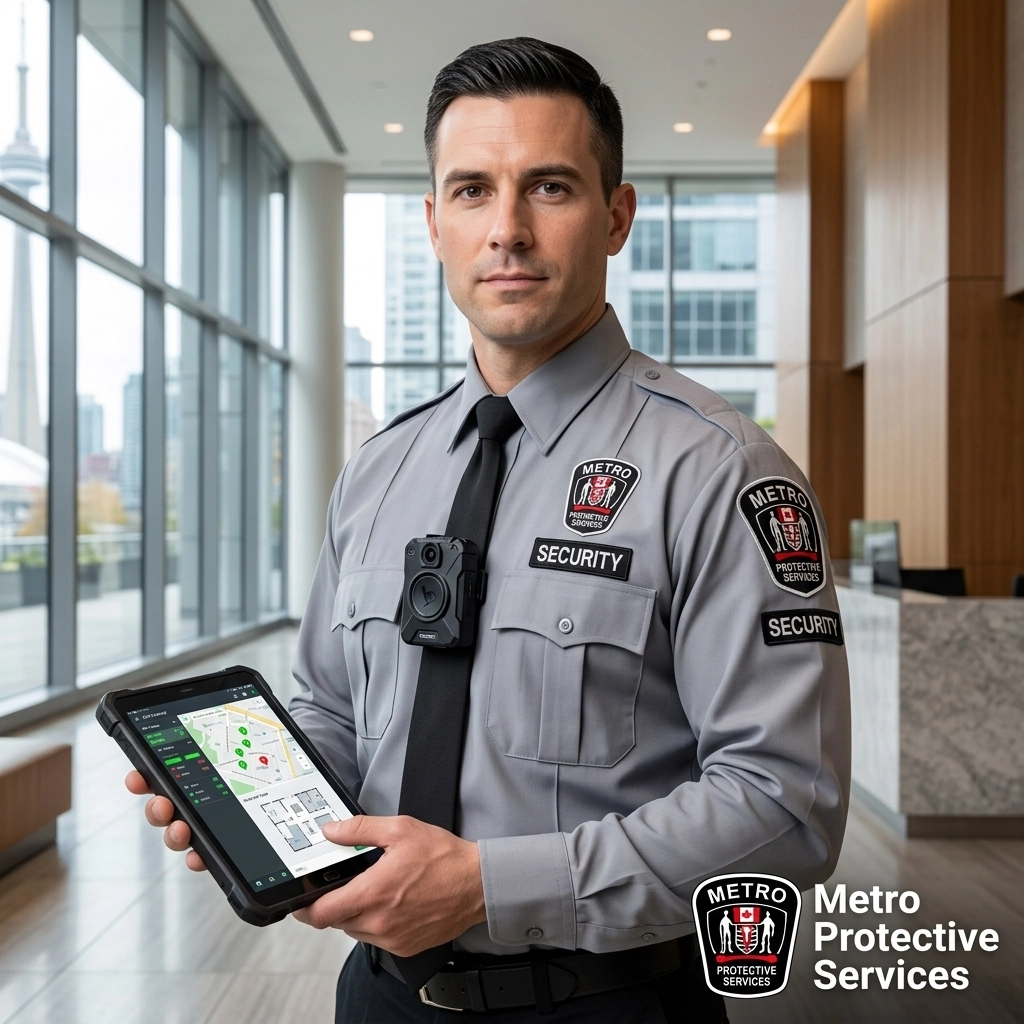
The Sky-Guard Monitoring System complements the guard’s physical presence with GPS check-ins and electronic reporting. Depending on the service plan, reports may include patrol details, incident notes, photographs, timestamps, and location information.
For property managers, this creates a more useful operational record than relying solely on verbal updates or paper logs. It also helps identify recurring concerns, such as repeated access attempts, poorly lit areas, unsecured doors, or disturbances concentrated at specific times.
Maintaining Professional Standards in Security
Professional standards are central to tenant confidence. Uniform presentation, punctuality, alertness, respectful communication, and accurate reporting all affect how a security program is perceived.
Metro’s retail and commercial security services are designed to support both protection and customer experience. In residential settings, concierge services can combine lobby security, access awareness, visitor assistance, and a welcoming front-of-house presence.
A professional standard should include:
- Wearing the approved uniform correctly and maintaining a clean, presentable appearance.
- Remaining attentive rather than relying on a passive desk presence.
- Treating tenants, customers, residents, and members of the public with courtesy.
- Avoiding discrimination, personal arguments, and unnecessary physical contact.
- Following post orders and client-approved standard operating procedures.
- Reporting facts rather than assumptions or exaggerated conclusions.
- Protecting confidential information and respecting privacy.
- Knowing when to request supervisory, medical, or police assistance.
- Reviewing incidents to improve procedures and future training.
Security personnel should also understand the limits of their role. Their responsibility is to deter, observe, communicate, document, and respond within lawful and client-approved procedures. They should not attempt to act as social workers, medical professionals, or police officers.
For additional context on the value of verifiable reporting, Metro’s article on real-time GPS reporting for security services in Toronto explains how electronic activity records can improve oversight.
Building a Tenant-Focused Tactical Security Plan
A strong plan begins with a site assessment. Property managers should identify tenant concerns, incident history, vulnerable access points, operating hours, parking patterns, and locations where people commonly gather or seek shelter.
The next step is to establish practical procedures. These should define who receives notifications, when dispatch is contacted, when police or emergency services are called, and how incidents are documented. Guards should be briefed on the difference between routine service issues and situations that require immediate disengagement.
Finally, management should review results. Useful measures may include:
- Tenant feedback regarding guard courtesy and responsiveness.
- Recurring incident locations and time periods.
- Patrol completion and checkpoint data.
- Response and notification times.
- Complaints involving security interactions.
- Incidents resolved without unnecessary disruption.
- Corrective actions completed after reported deficiencies.
The objective is not to create an unnecessarily forceful environment. It is to create a predictable, professional, and responsive one.
Conclusion
For GTA property managers and commercial operators, tactical security is increasingly connected to tenant retention. Vagrancy, break-ins, suspected drug use, and public disorder can affect occupancy and customer confidence, but the response matters just as much as the incident itself.
Professional security guard services Toronto businesses can rely on should combine visible prevention, practical de-escalation, clear escalation thresholds, and accountable reporting. For organizations seeking commercial security services GTA properties can implement with consistency, Metro Protective Services provides trained personnel, 24/7 dispatch coordination, and Sky-Guard technology to support responsive protection.
Whether the requirement involves retail loss prevention, commercial patrols, residential lobby security, or specialized tactical security Toronto properties need in higher-risk environments, the goal remains the same: protect people, preserve dignity, support tenants, and maintain professional standards on every shift.
Need Help? Chat with Us
Metro Protective Services provides tailored security solutions for retail, commercial, residential, construction, industrial, and mixed-use properties throughout Toronto and the GTA.
Submit a Request for a Quote or contact the team to discuss your site requirements.
Recent Posts
- How to Choose the Best Security Guard Services in Toronto: 2026 Comparison
- Comprehensive Security Guard and Property Protection Services in Toronto and the GTA
- Construction Site Security Services in Toronto: Protecting Equipment, Materials, and Project Timelines
Reference

