

-
info@Metroprotective.ca
Send Email
-
Toronto – Hamilton – London – Windsor
Metro Protective Services
Tel: 416-240-0911
Confidentiality Guaranteed
Tel: 416-240-0911
Confidentiality Guaranteed
04
Sep
Sep
After-Hours Mall Security: Protecting Vacant Units, Storefronts, and Common Areas
Breadcrumbs: Home → Blog → Mall Security
Published: August 29, 2026
Category: Mall Security
Tags: Mall Security Toronto, Mobile Patrol, Retail Security, Vacant Unit Protection, Alarm Response, Retail Loss Prevention
When a shopping centre closes, the security requirements do not end. They change.
During operating hours, security teams manage customer safety, visible deterrence, tenant support, and retail loss prevention. After closing, the focus shifts toward controlling access, protecting vacant units, checking storefronts, monitoring loading corridors, responding to alarms, and identifying signs of forced entry or vandalism before they become major losses.
For mall owners, property managers, and retail plaza operators, an effective overnight plan requires more than a guard stationed at a front entrance. It requires a documented process that accounts for every phase of the transition from open to closed: lock-up, overnight patrol, alarm response, early access, and morning unlock.
Why After-Hours Mall Security Requires a Different Strategy
A shopping centre becomes more vulnerable after most customers and employees leave. There are fewer witnesses, reduced activity in common areas, and longer response times for property representatives or tenants. Vacant units may remain dark for extended periods, while loading docks, service corridors, parking areas, and rooftop access points may receive less regular attention.
At the same time, some activity continues. Cleaners, contractors, delivery personnel, maintenance teams, and authorized tenant employees may need access outside normal operating hours. Security must distinguish legitimate activity from unauthorized entry without disrupting approved business operations.
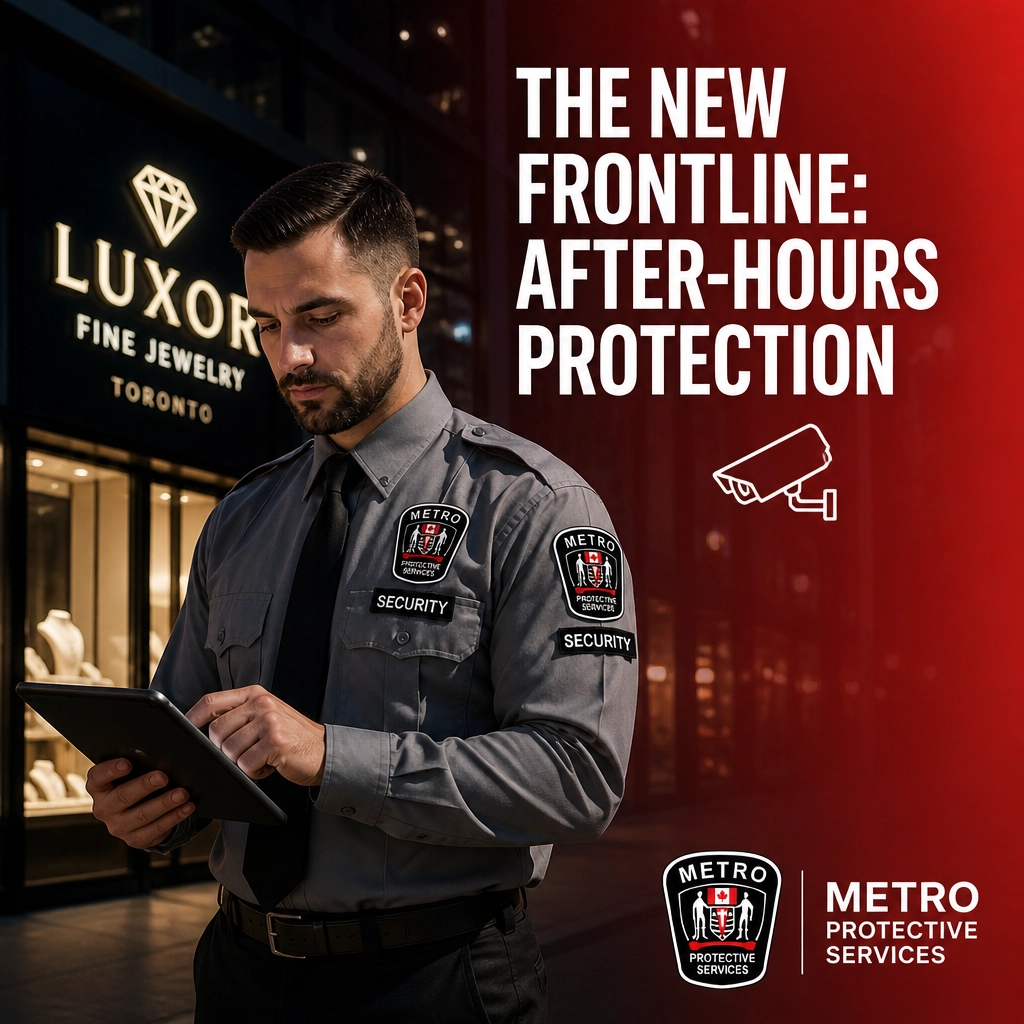
This is where professional mall security in Toronto supports the property management team. Guards can enforce access procedures, conduct physical inspections, coordinate responses through a 24/7 dispatch centre, and provide clear electronic reports for management review.
1. Establish a Controlled Lock-Up Procedure
The closing period should follow a consistent sequence rather than relying on informal communication between tenants and security staff.
A typical lock-up procedure should include:
- Confirming the official closing time and any approved extensions.
- Identifying tenants, cleaners, contractors, or employees who remain on site.
- Checking that public entrances are closed and secured.
- Verifying that storefront doors, gates, shutters, and rear service doors are locked.
- Inspecting emergency exits to ensure they are closed, unobstructed, and not propped open.
- Sweeping common areas such as corridors, food courts, washrooms, stairwells, and elevators.
- Checking loading bays and back-of-house corridors for unauthorized activity.
- Confirming that alarm systems and scheduled security controls are operating as expected.
- Recording unresolved issues and notifying the appropriate property contact.
A grace period may be appropriate for tenants completing cash handling, cleaning, or closing tasks. However, extended access should be authorized and documented. Clear procedures reduce confusion and provide a reliable record when an incident occurs later in the night.
2. Protect Vacant Units and Dark Storefronts
Vacant units often attract vandalism, unauthorized entry, illegal dumping, and other forms of property damage. They can also create blind spots along a mall’s interior corridors, particularly when neighbouring tenants have limited visibility after closing.
Security planning for vacant units should include:
- Checking doors, locks, frames, windows, and temporary barriers for damage or tampering.
- Confirming that public and service entrances are secured.
- Restricting access to authorized leasing, maintenance, or construction personnel.
- Requiring contractors to sign in and out, provide identification, and follow approved work orders.
- Including vacant units in scheduled patrol routes.
- Monitoring adjacent corridors and service areas for unusual activity.
- Reporting water leaks, broken glass, damaged lighting, or other conditions that may compromise security.
- Ensuring that cameras and intrusion devices covering the unit are functioning and included in after-hours monitoring.
A guard should not enter a vacant unit simply because an unusual sound or alarm has been reported. The response should follow the site’s established procedures, beginning with an exterior assessment and escalation when signs of forced entry or criminal activity are present.

3. Use Mobile Patrol to Cover the Full Property
Fixed posts provide visibility at designated locations, but they do not replace movement throughout a large shopping centre or retail plaza. Mobile patrol services in Toronto can extend coverage across parking areas, perimeter roads, loading zones, service entrances, and isolated sections of a property.
An effective after-hours patrol schedule may combine:
- Interior foot patrols through common areas and back-of-house corridors.
- Vehicle patrols around surface parking lots and parking structures.
- Checks of loading docks, waste areas, and delivery routes.
- Inspections of rooftop doors, mechanical areas, and other restricted access points.
- Repeated checks of vacant units and dark storefronts.
- Observation of parked vehicles that remain on the property for unusual periods.
- Verification that emergency exits and fire lanes remain accessible.
- Inspection of exterior lighting and areas with reduced visibility.
Patrol routes should be structured but not unnecessarily predictable. Supervisors can adjust frequency and priority based on incident history, tenant concerns, construction activity, seasonal conditions, or changes to the property layout.
Each patrol should be documented with the time, location, observations, and actions taken. Electronic reporting gives property managers a timely record of completed checks and allows recurring concerns to be identified before they become larger operational problems.
4. Monitor Loading Corridors, Roof Access, and Service Areas
After-hours incidents frequently involve areas that are separate from the customer-facing mall environment. Loading corridors and service entrances may provide access to multiple tenants, storage rooms, garbage enclosures, and mechanical spaces.
Security personnel should verify:
- Delivery schedules and authorized personnel.
- Identification and work orders for contractors.
- That delivery doors are closed when not actively in use.
- That service corridors are free of unauthorized persons.
- That roof access doors and stairwell doors are secured.
- That mechanical and utility areas are accessible only to approved personnel.
- That unsecured ladders, tools, or materials are reported.
- That exterior gates and perimeter access points are closed and functional.
These checks are particularly important when construction, renovations, or tenant improvements are underway. Temporary workers and changing access requirements can create weaknesses unless the property’s security plan is updated and communicated.
5. Respond to Alarms Using a Defined Process
Alarm response must be prompt, controlled, and documented. The response should begin with dispatch coordination, including the location, type of alarm, and any available camera information.
When an alarm is received, the security team should:
- Record the alarm time, location, and system zone.
- Notify the appropriate on-site supervisor or property contact.
- Review available camera coverage when possible.
- Assign the nearest qualified officer to assess the area.
- Conduct an exterior inspection before entering.
- Check doors, shutters, windows, roof access, and nearby corridors for signs of tampering.
- Secure the area and contact emergency services when forced entry or a crime is suspected.
- Avoid disturbing potential evidence.
- Confirm the cause before any authorized reset.
- Complete an incident report and identify any required follow-up.
Repeated false alarms should not be treated as routine. Trend analysis may reveal a defective sensor, an incorrect tenant closing procedure, a door that is not latching properly, or a recurring access-control issue.
6. Maintain Lighting and Vandalism Prevention Measures
Lighting is a practical component of after-hours mall security. Dark areas can conceal unauthorized activity and make it more difficult for guards, cameras, tenants, and emergency responders to assess conditions.
Property managers should ensure that:
- Parking lots and pedestrian routes are adequately illuminated.
- Exterior building lights remain operational.
- Service entrances and loading docks are not left in darkness.
- Vacant storefronts have sufficient corridor visibility.
- Damaged lights are reported and repaired promptly.
- Landscaping, signage, and temporary structures do not create avoidable hiding places.
- Graffiti, broken windows, dumped materials, and other vandalism indicators are recorded and escalated.
Visible patrol activity, consistent inspections, and prompt reporting work together as a deterrent. They also demonstrate that the property is being actively managed even when most businesses are closed.

After-Hours Mall Security Checklist
Property managers can use the following checklist when reviewing their overnight security plan:
- Closing and lock-up responsibilities are clearly assigned.
- Approved after-hours personnel are identified and logged.
- Storefronts, service doors, and emergency exits are checked.
- Vacant units are included in patrol routes.
- Loading corridors and rooftop access are inspected.
- Parking areas and property perimeters receive regular coverage.
- Alarm response procedures are written and tested.
- Lighting deficiencies are reported promptly.
- Mobile patrol routes reflect current risks.
- Supervisors review incidents and recurring concerns.
- Daily electronic reports are available to property management.
- Tenant contacts and emergency escalation procedures are current.
A Reliable Overnight Security Partner for Toronto Properties
Metro Protective Services has served Toronto and the GTA since 2000. Our security guard services in Toronto support shopping centres, retail plazas, commercial properties, and multi-tenant facilities with trained personnel, supervisor oversight, 24/7 dispatch coordination, mobile patrol, access control, alarm response, and electronic reporting.
Our approach combines professional visibility with practical property protection. Whether a client requires a dedicated overnight officer, scheduled mobile patrol services, retail loss prevention support, or a broader security program, the plan can be structured around the property’s layout, tenant operations, risk profile, and reporting requirements.
Need Help Reviewing Your Mall’s After-Hours Security Plan?
A secure shopping centre requires more than a closing-time walkthrough. It requires consistent procedures, accountable patrol coverage, and a clear response when something does not look right.
Contact Metro Protective Services to discuss after-hours mall security, mobile patrol, storefront protection, and retail loss prevention services across Toronto and the GTA.
Need Help? Chat with us or submit your security requirements now.
Recent Posts

