

-
info@Metroprotective.ca
Send Email
-
Toronto – Hamilton – London – Windsor
Metro Protective Services
Tel: 416-240-0911
Confidentiality Guaranteed
Tel: 416-240-0911
Confidentiality Guaranteed
01
Sep
Sep
Organized Retail Crime in Shopping Centres: A Coordinated Mall Loss-Prevention Strategy
Home > Blog > Retail and Commercial Security
Published: August 29, 2026
Series: Mall Security in Toronto and the GTA : Article 3 of 14
Category: Retail Loss Prevention
Tags: Organized Retail Crime, Mall Security Toronto, Retail Loss Prevention, Security Guard Services Toronto, Shopping Centre Security
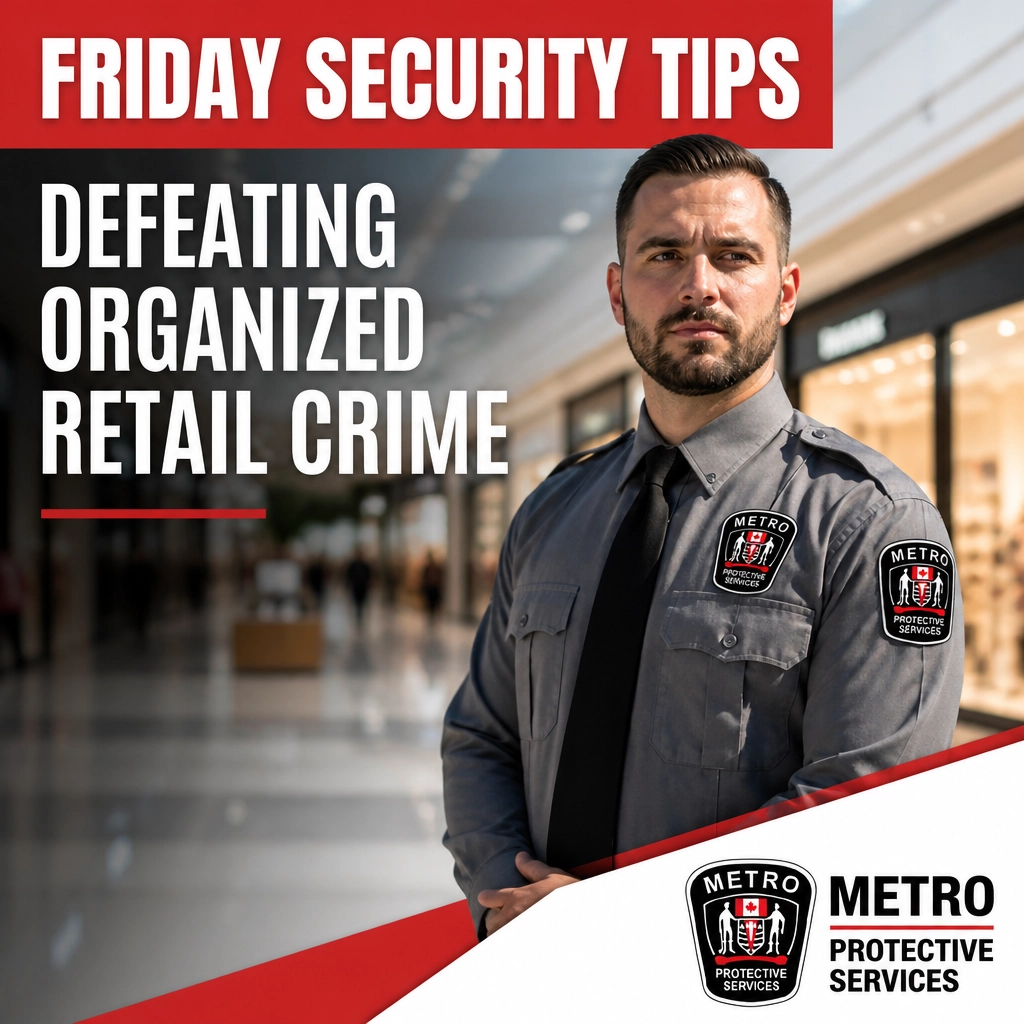
Organized retail crime creates challenges that individual stores cannot always manage alone. Theft crews may move between tenants, use coordinated distractions, target specific product categories, and return repeatedly when responses are inconsistent. A store-by-store approach can leave important information fragmented and allow repeat offenders to exploit gaps between retailers, mall security, and property management.
A coordinated shopping-centre strategy connects observation, communication, documentation, tenant support, and lawful escalation. The goal is not to encourage unsafe intervention. It is to create a structured environment where suspicious activity can be identified early, information can be shared appropriately, evidence can be preserved, and staff and customers remain protected.
Why organized retail crime requires a mall-wide response
Organized retail crime is different from an isolated shoplifting incident. It may involve multiple individuals performing separate roles, including observation, distraction, merchandise removal, transportation, or rapid exit. A group may visit several stores in one centre or return at predictable times to target high-value merchandise.
When every tenant handles these incidents independently, several problems can occur:
- Similar incidents are recorded in different formats.
- Repeat offenders are not recognized across stores.
- Relevant video is overwritten or not collected promptly.
- Mall security receives incomplete information.
- Staff may respond inconsistently during stressful situations.
- Property management lacks reliable data for adjusting patrols and procedures.
A mall-wide loss-prevention program provides a common operating framework. It allows tenants, security officers, management, and law enforcement to work from consistent information while respecting privacy obligations, workplace-safety requirements, and applicable Ontario law.

1. Establish coordinated communication between tenants
The first requirement is a clear communication process. Every tenant should know how to contact mall security, what information to provide, and when an incident requires immediate police assistance.
A practical communication procedure should identify:
- The store or area where the concern was observed.
- The time of the observation.
- The behaviour creating concern.
- The number of people involved.
- Clothing, bags, vehicles, or other observable identifiers.
- The direction of travel, if the individuals leave.
- Whether there is a threat, weapon, injury, or immediate danger.
Communication should focus on observable behaviour rather than assumptions about a person’s identity or background. For example, a report describing coordinated distraction, removal of security devices, or repeated movement between several high-value displays is more useful than a vague description.
Mall security can then assess the situation, notify appropriate personnel, and provide a concise alert to other tenants when warranted. These communications must be controlled, professional, and consistent with the centre’s privacy policies.
2. Use trained officers for safe observation
Effective retail loss prevention depends on identifying patterns without creating unnecessary risk. Security officers should be positioned according to the shopping centre’s risk profile, with attention to entrances, exits, high-value retailers, fitting rooms, loading areas, parking routes, and other locations where offenders may attempt to transfer merchandise.
Observation may include:
- Monitoring movement between multiple stores.
- Identifying coordinated distraction behaviour.
- Noting repeated visits during predictable time periods.
- Recording vehicle descriptions when relevant and lawful.
- Observing entry and exit routes.
- Communicating with tenant management without escalating the situation.
The purpose of observation is to support a measured response. Officers should not act outside their training, chase individuals into unsafe areas, or place customers and employees at risk to recover merchandise.
Metro Protective Services provides trained security professionals for retail and commercial environments throughout Toronto and the GTA. Our loss prevention services are designed to support prevention, deterrence, surveillance, incident resolution, and coordination with client procedures.
3. Standardize incident documentation
Consistent documentation helps connect separate incidents and gives property management a reliable basis for decision-making. Each tenant should use a common incident-reporting standard, even if the retailer also completes its own corporate report.
A useful report should include:
- Date, time, and precise location.
- Names or roles of reporting staff and responding officers.
- A factual description of observed behaviour.
- Suspect descriptions based on observable characteristics.
- Merchandise involved and approximate value.
- Any damage, threats, or injuries.
- Direction of travel and vehicle information, when available.
- Names of witnesses.
- Relevant camera locations.
- Actions taken and agencies contacted.
- Follow-up required.
Reports should be completed as soon as practical while details remain clear. Statements should distinguish between direct observations and information received from another person. Avoid conclusions that cannot be supported by evidence.
Daily electronic reporting also helps property managers identify trends across shifts, tenants, and locations. Metro’s professional standards include detailed reporting, supervisor oversight, and coordinated communication for clients requiring a dependable security presence.
4. Preserve evidence before it is lost
Video evidence is often central to understanding an organized retail crime incident. However, useful footage can be lost when no one identifies the relevant cameras or exports the recording promptly.
After a significant incident, the responsible team should:
- Identify the store, corridor, entrance, parking, and loading-area cameras that may have captured the event.
- Preserve footage from several minutes before and after the incident.
- Retain the original file where possible.
- Record the camera number, location, date, and time.
- Note who exported, reviewed, or transferred the footage.
- Store the file securely and limit access to authorized personnel.
- Link related video to the corresponding incident report.
Tenant point-of-sale records, inventory information, receipts, product lists, and photographs of damage may also be relevant. Evidence should be collected lawfully and provided to police or authorized investigators through an established process.
The Retail Council of Canada’s loss-prevention resources provide additional industry context for retailers and property operators developing coordinated procedures.
5. Protect staff through de-escalation and clear limits
Loss prevention must never become a reason for employees to take unnecessary physical risks. Store staff and security officers should receive practical training on verbal de-escalation, maintaining distance, recognizing warning signs, and requesting assistance.
A safe response may include:
- Using a calm, neutral tone.
- Avoiding arguments, accusations, or sudden movements.
- Maintaining a safe position and keeping an exit route available.
- Moving customers and employees away from a developing confrontation.
- Calling mall security or 911 when there is an immediate threat.
- Following the centre’s no-chase and no-physical-intervention policies.
- Reporting threats, intimidation, or violence even when merchandise is recovered.
After an incident, management should check for injuries, document the event, and conduct a short debrief. A debrief should identify what occurred, whether communication worked, and whether procedures or staffing require adjustment. Guidance from Workplace Safety and Prevention Services also emphasizes the importance of preparing employees for rising retail theft and violence risks.
6. Apply lawful escalation and repeat-offender procedures
Mall management should establish a documented process for escalating incidents to police, corporate loss-prevention teams, legal counsel, and other authorized contacts. The process should define when an incident is urgent, when a pattern requires investigation, and how evidence will be shared.
For repeat offenders, property managers may consider trespass notices or banning procedures where appropriate. These actions should be reviewed with legal counsel and applied consistently. Records must be handled according to applicable privacy and retention requirements.
A mall-wide incident history can help identify repeat patterns, but it should not become an informal or uncontrolled watchlist. Information should be accurate, access-limited, regularly reviewed, and supported by documented events.
Mall loss-prevention readiness checklist
Property managers and tenant coordinators should confirm that:
- Every tenant knows how to contact mall security.
- Security officers understand priority locations and patrol objectives.
- Incident reports use consistent fields and terminology.
- Relevant video can be exported and preserved quickly.
- Tenants understand no-chase and de-escalation expectations.
- Police and emergency-contact procedures are current.
- Repeat incidents are reviewed across the entire property.
- Staff receive regular training and post-incident support.
- Privacy, trespass, and evidence procedures have been reviewed.
- Management measures results and updates the plan.
Why choose Metro Protective Services for mall security?
Since 2000, Metro Protective Services has supported businesses and property managers across Toronto and the GTA with professional security guard services. Our trained officers provide visible deterrence, safe observation, tenant coordination, incident reporting, access-control support, and responsive assistance for retail and commercial properties.
Our retail and commercial security services can be structured around the needs of a shopping centre, including patrol coverage, loss prevention support, emergency response procedures, and coordination with property management. Our 24/7 dispatch coordination helps ensure that concerns are directed promptly, while professional standards and detailed reporting support accountability after each shift.
Need Help? Chat with us or contact Metro Protective Services to discuss a coordinated mall security plan.

