

-
info@Metroprotective.ca
Send Email
-
Toronto – Hamilton – London – Windsor
Metro Protective Services
Tel: 416-240-0911
Confidentiality Guaranteed
Tel: 416-240-0911
Confidentiality Guaranteed
17
Sep
Sep
Retail Loss Prevention Services in Toronto and the GTA: Reducing Shrink, Theft, and Store Risk
Breadcrumb: Home > Security Services > Loss Prevention
Published: September 17, 2026
Category: Loss Prevention
Tags: Retail Security, Loss Prevention, Organized Retail Crime, Shrink Reduction, Toronto Security, GTA Security
Retail shrink is rarely caused by one issue. Shoplifting, organized retail crime, refund fraud, employee theft, receiving errors, poor access control, and inadequate after-hours coverage can all contribute to financial loss. For retailers, shopping malls, plazas, grocery stores, pharmacies, and big-box environments across Toronto and the GTA, loss prevention must address both security incidents and operational weaknesses.
Professional retail loss prevention combines trained personnel, clear procedures, effective communication, and reliable documentation. A guard presence should protect merchandise and employees while supporting a safe, welcoming customer experience.
Metro Protective Services has provided professional security solutions across Toronto and the GTA since 2000. Our trained security professionals support retail and commercial clients with visible deterrence, access control, incident reporting, mobile patrol, 24/7 dispatch coordination, and technology-supported oversight.
Build a Visible and Flexible Retail Security Presence
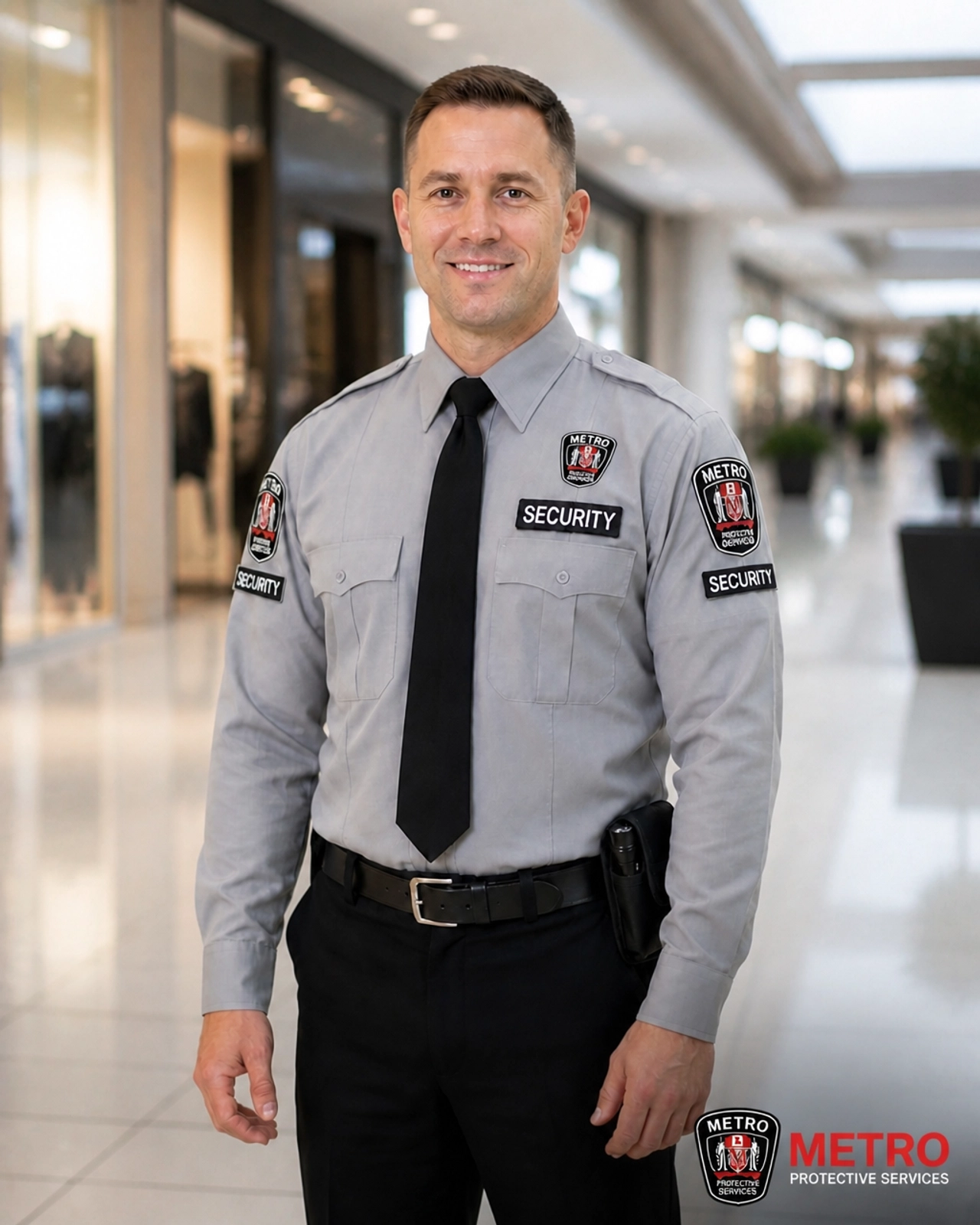
Uniformed security guards provide an immediate deterrent. Positioning a trained officer near entrances, exits, high-shrink aisles, self-checkout areas, or customer service desks can increase perceived oversight and allow concerns to be identified early.
Visible coverage is particularly useful for:
- Retail entrances and exits
- Pharmacy and personal-care departments
- Electronics, liquor, cosmetics, and other high-value areas
- Fitting rooms and customer service counters
- Self-checkout and refund desks
- Parking-lot access points and mall common areas
Uniformed officers should remain professional, observant, and approachable. Their role is not simply to stand at a door. They can welcome customers, communicate with store staff, identify safety concerns, monitor activity, and respond according to approved site procedures.
Some retailers also benefit from discreet, plainclothes loss prevention coverage. A combination of uniformed and plainclothes personnel can provide both visible deterrence and covert observation. The appropriate model depends on the store format, incident history, merchandise profile, operating hours, and customer environment.

Monitor Fitting Rooms, Exits, and Receipt Verification Professionally
Fitting rooms and exit areas require careful attention because they can become points of concealment, product transfer, or confusion during busy periods. Guards and store employees should coordinate on fitting-room checks, abandoned merchandise, alarm activations, and customer-service concerns without making assumptions based on appearance.
Receipt and cart verification must be conducted consistently, respectfully, and in accordance with the retailer’s written policy. Clear signage and staff training help customers understand that the process is routine rather than personal.
Effective procedures include:
- Applying checks consistently rather than selectively
- Using behaviour-based observations instead of assumptions
- Requesting receipts politely and allowing customers time to respond
- Involving a supervisor when a discrepancy is identified
- Avoiding unnecessary confrontation at the exit
- Escalating concerns through the store’s approved process
Retail security personnel should never improvise enforcement procedures. Their responsibilities must be defined in site orders, client policies, and applicable legal and licensing requirements.
Establish Clear Boundaries for Theft Response
Loss prevention personnel may observe suspicious behaviour, document events, protect people and property, and report incidents. Any detention, apprehension, or physical intervention must be handled only where permitted by applicable law, client policy, training, and the officer’s authority.
A sound retail response procedure generally follows these principles:
- Observe: Identify conduct, location, time, merchandise, and involved individuals.
- Communicate: Notify the store manager, security supervisor, or dispatch centre according to the site plan.
- Document: Record facts objectively, including descriptions, actions, witness information, and available video references.
- Report: Contact police or emergency services when required by the circumstances and established procedures.
- Do not pursue beyond policy: Officers should not engage in unsafe pursuits through parking areas, public streets, or neighbouring properties unless specifically authorized and lawful under the applicable response plan.
The primary priorities are safety, lawful conduct, accurate reporting, and preservation of evidence. Merchandise recovery must not create an unnecessary risk to customers, employees, guards, or members of the public.
Address Organized Retail Crime and Repeat Offenders
Organized retail crime may involve coordinated teams, distraction tactics, repeated visits, large quantities of targeted merchandise, or the use of multiple locations. Retailers should look beyond isolated events and assess patterns across departments, shifts, stores, and properties.
A coordinated loss prevention program can support:
- Incident trend analysis by time, location, and product category
- Internal alerts for known patterns or repeat incidents
- Communication between store management, security, and authorized investigators
- Preservation of CCTV clips, photographs, transaction details, and witness accounts
- Timely reporting to police or other appropriate authorities
- Review of vulnerabilities in entrances, exits, storage areas, and refund processes
Security providers should not encourage staff to confront suspected organized crime groups independently. Instead, retailers should establish a documented escalation process that allows management, security supervisors, and law enforcement to coordinate appropriately.
Reduce Internal Shrink and Refund Fraud
Retail loss prevention also includes protecting the business from internal theft, collusion, refund fraud, sweethearting, inventory manipulation, and unauthorized discounts. These issues require discretion and careful documentation.
Security teams can assist by monitoring employee entrances, stockroom access, receiving areas, and restricted zones. They may also identify unusual patterns for management review, such as repeated refunds, product movement outside normal procedures, or access to controlled areas without an operational reason.
Security personnel should document observable facts rather than make accusations. Investigations involving employees should remain confidential and be directed by authorized store management or qualified investigators.
Control Receiving, Delivery Docks, and Stockrooms
Delivery and receiving areas are common points of vulnerability because products, vendors, contractors, and employees move through the same space. A well-designed control procedure should address:
- Vendor and driver identification
- Delivery appointment verification
- Shipping and receiving documentation
- Seal, pallet, and package checks
- Restricted stockroom access
- Employee-only doors and emergency exits
- Key, access card, and alarm procedures
- Reporting of damaged, missing, or unaccounted-for merchandise
For larger retail properties and shopping plazas, security guard services Toronto can be integrated with property management, tenant operations, loading dock procedures, and common-area patrols.
Coordinate CCTV, Alarms, and Electronic Reporting
CCTV is most useful when it is connected to a defined response and documentation process. Cameras should support coverage of entrances, exits, checkout areas, high-value merchandise, fitting rooms where legally and appropriately configured, stockrooms, loading docks, employee access points, and parking areas.
Security personnel can coordinate with store management to:
- Identify relevant camera views during an incident
- Record the date and time of footage
- Preserve video clips and still images
- Connect footage to incident report numbers
- Document alarm activations and dispatch communications
- Maintain evidence securely and limit access to authorized personnel
Metro Protective Services supports retail clients with a 24/7 dispatch centre, daily electronic reports, and the Sky-Guard Monitoring System. GPS check-ins and electronic reporting help management verify patrol activity, review observations, and maintain a timely record of services delivered.

Plan for After-Hours Security and Alarm Response
Retail properties remain vulnerable after closing. Mobile patrol and alarm response can provide an additional layer of protection for storefronts, shopping plazas, pharmacies, warehouses, and big-box locations.
After-hours procedures may include:
- Scheduled and random exterior patrols
- Door, gate, and lock checks
- Perimeter inspections
- Alarm response and keyholder notification
- Reporting of broken glass, forced entry, lighting failures, or unsecured doors
- Coordination with property managers and emergency contacts
Metro’s mobile patrol services Toronto support scheduled patrols, alarm responses, lock and unlock assistance, key management, and electronic reporting.
For businesses with multiple site risks, security planning may also include construction site security services during renovations or expansions, as well as residential security Toronto solutions for mixed-use properties with retail and residential components.
Protect the Customer Experience
Loss prevention should reduce risk without making legitimate customers feel unwelcome or profiled. Effective programs focus on behaviour, circumstances, and documented procedures rather than personal characteristics.
Guards should receive training in:
- Respectful customer interaction
- De-escalation and verbal communication
- Cultural awareness
- Conflict avoidance
- Appropriate use of observation and reporting
- Maintaining a calm presence during stressful events
A professional guard can deter theft while also helping customers find an entrance, locate a service desk, report a hazard, or request assistance. Security should support the store’s operations, not interfere unnecessarily with them.
Retail Loss Prevention Checklist for Managers
Use this checklist when reviewing your current program:
- Are entrances, exits, high-shrink aisles, and self-checkout areas covered?
- Is the balance between uniformed and plainclothes coverage appropriate?
- Are fitting-room, exit, receipt, and cart-verification procedures written and consistent?
- Do employees know when to contact security or a manager?
- Are theft response and no-pursuit boundaries clearly defined?
- Are repeat incidents and organized retail crime patterns reviewed?
- Are refunds, discounts, inventory adjustments, and employee access monitored?
- Are receiving docks, stockrooms, keys, and restricted doors controlled?
- Can CCTV footage and alarm logs be quickly preserved?
- Are incident reports completed during or immediately after each significant event?
- Are keyholders and emergency contacts current?
- Are after-hours patrols and alarm responses tested?
- Do management and security review trends regularly?
Metro Protective Services provides retail and commercial security for stores, shopping centres, plazas, pharmacies, grocery locations, warehouses, and commercial properties throughout Toronto and the GTA. Our trained guards, 24/7 dispatch centre, electronic reporting, and Sky-Guard Monitoring System support a measurable and coordinated loss prevention strategy.
Need Help? Chat with Us
If your business is experiencing theft, shrink, access control issues, or recurring after-hours incidents, Metro Protective Services can help assess the site and recommend an appropriate coverage plan.
- Phone: 416-240-0911
- Email: info@metroprotective.ca
- WhatsApp: Start a conversation
- Contact page: Submit a security consultation request
Submit now to discuss retail loss prevention coverage for your store, mall, plaza, or commercial property.
Leave a Comment
Have a retail security question? Leave a comment or contact Metro Protective Services for a prompt response from our team.
Recent Posts
- Stop Wasting Time on Unreliable Security Companies Toronto: Try These 7 Quick Hacks : September 17, 2026
- Comprehensive Security Guard and Property Protection Services in Toronto and the GTA : September 16, 2026
- Struggling for Site Safety? 50+ Real-Life Security Guard Services Toronto Examples : September 16, 2026
- Retail Loss Prevention and Industrial Security in Toronto: A Proactive Approach to Asset Protection : July 23, 2026
One Comment
Leave a Comment


Mobile Patrol Services in Toronto and the GTA: Extending Security Coverage Beyond the Guard Post – Metro Protective Services
17 Sep, 2026[…] Retail Loss Prevention Services in Toronto and the GTA: Reducing Shrink, Theft, and Store Risk […]