

-
info@Metroprotective.ca
Send Email
-
Toronto – Hamilton – London – Windsor
Metro Protective Services
Tel: 416-240-0911
Confidentiality Guaranteed
Tel: 416-240-0911
Confidentiality Guaranteed
26
Oct
Oct
Comprehensive Security Guard and Property Protection Services in Toronto and the GTA: Retail Loss Prevention That Starts Behind the Sales Floor This Holiday Season
Breadcrumb: Home › Blog › Retail Loss Prevention
Scheduled: Monday, October 26, 2026, at 1:00 p.m. Toronto time
Series: Comprehensive Security Guard and Property Protection Services in Toronto and the GTA, Entry 24
Category: Retail Loss Prevention | Commercial Security | Security Guard Services | Holiday Property Protection
Holiday retail security is often discussed in terms of customer traffic, but retail loss prevention also depends on the controls operating behind the sales floor. For businesses seeking security guard services Toronto retailers can use to support commercial security, the seasonal build-up is a useful time to review staff access, cash handling, deliveries, refunds and third-party entry.
The Retail Council of Canada’s 2025 report estimates that retail shrink averages 1.5% of sales, or roughly $9.2 billion annually across Canadian retail. Shrink includes more than theft: depending on the retailer’s definition, it can include process failures, errors and other losses. For property groups with mixed-use portfolios, the same planning discipline may also connect retail operations with concierge security services at the front of the building and residential security Toronto coverage in the towers above.
Where Retail Loss Prevention Actually Fails During Peak Season
The holiday build-up changes the operating rhythm of a store. More deliveries arrive, staff schedules expand, temporary workers move between tasks, and returns begin to increase. In this environment, individual exceptions can be harder to notice unless roles, access and reporting routines are clear.
The Retail Council of Canada / Loss Prevention Research Council 2025 report identifies employee theft as a category for which every respondent recorded summary and detailed incident data. Cash and deposit theft was recorded by 91.3% of respondents. The figures do not mean that every retailer experiences these incidents; they show that internal loss is a consistently tracked category across the survey respondents.
The report also found that fraudulent returns were among the incident types least likely to have both summary and detailed records, at 65.2%. This difference points to a practical question for retailers: do existing processes capture enough information to recognise patterns in refunds and exceptions, or do they only document the immediate transaction?
A separate forecast offers context for the workload ahead, but it is not a Canadian estimate. The U.S. National Retail Federation forecast, reported by Retail Dive on October 19, 2026, expects holiday sales to grow 4.2% to roughly US$1 trillion, with U.S. retailers expected to hire 325,000 to 375,000 seasonal workers. Canadian operators may be watching this forecast as an indicator of a busy retail season, but it should not be interpreted as a Canadian sales or hiring figure.
What Security Guard Services Toronto Managers Should Cover Before Seasonal Staff Arrive
Temporary and seasonal employees are part of the holiday operating plan. The security concern is not the status of a worker; it is whether every person understands their assigned duties and has access only to the areas and systems required for those duties.
Before shifts begin, managers can review how new employees receive store-specific orientation, who supervises them, and how responsibilities are handed over between teams. Access cards, keys, register permissions and refund authority should be assigned according to role and removed or updated promptly when assignments change or employment ends. A simple process for reporting misplaced credentials can also help management respond consistently.
Security personnel can provide a visible, professional presence, observe designated areas and report activity that falls outside site procedures. They should not be treated as substitutes for store supervisors, cash-office staff or internal investigators. Guards should not be asked to approve transactions, audit employee performance or handle cash unless that responsibility is expressly defined in the site post orders and appropriate procedures.
The guard’s role should be set out in written post orders: where to patrol, how to record observations, which manager to contact and how to escalate safety concerns. Staff should follow store procedures, avoid confronting or physically stopping suspected shoplifters, and contact police where appropriate. Apprehension, detention and use of force are governed by provincial licensing rules and the Criminal Code; site post orders set out guard duties, while store policy and legal counsel should guide detention decisions.
Cash, Deposits and Returns Need Consistent Exception Records
Peak transaction volumes can make routine discrepancies more difficult to review. Retailers can reinforce existing controls by confirming who may approve refunds, voids, discounts and register overrides, and by documenting the reason for an exception in the relevant system. Managers should determine whether repeated or unusual activity can be reviewed through their own transaction records.
Cash and deposits warrant similarly clear separation of responsibilities. Retail management should define who counts tills, who verifies amounts, how cash is transferred and who is authorised to access secure holding areas. A guard can observe and document activity within assigned duties, but should not become a substitute for the retailer’s cash-control process. If an escort or perimeter presence is required, the task, route, communications and reporting expectations should be agreed in advance.
Refund reviews should follow the retailer’s established policy. Useful records may include transaction time, location, authorisation, reason code and any required receipt or payment verification. A guard can report an observed safety or access concern; transaction approval and investigation remain with authorised store personnel.
Receiving Doors, Vendor Access and Renovations Need One Plan
Receiving areas can become especially active as stores accept replenishment, seasonal displays and vendor deliveries. Managers can set clear rules for delivery appointments, authorised entry points, visitor identification and staff escorts, then ensure that these rules are communicated to employees and contractors.
The guard’s duties can include monitoring a designated entrance, recording permitted access, noting unusual activity and notifying the designated manager when a delivery or visitor does not match site instructions. Guards should not be expected to certify a shipment, reconcile purchase orders or decide whether stock belongs to the retailer. Those are operational controls for authorised store staff.
Pop-up retailers, brand representatives, installers and other vendors should have defined access hours and work areas. Where a store or shopping property is under renovation, access plans should account for the overlap between retail operations and contractors, materials, tools and temporary barriers. Metro’s construction site security services can be considered where a separate construction-security plan is needed alongside retail coverage.
How Security Guard Services Toronto Retailers Can Support Back-of-House Controls
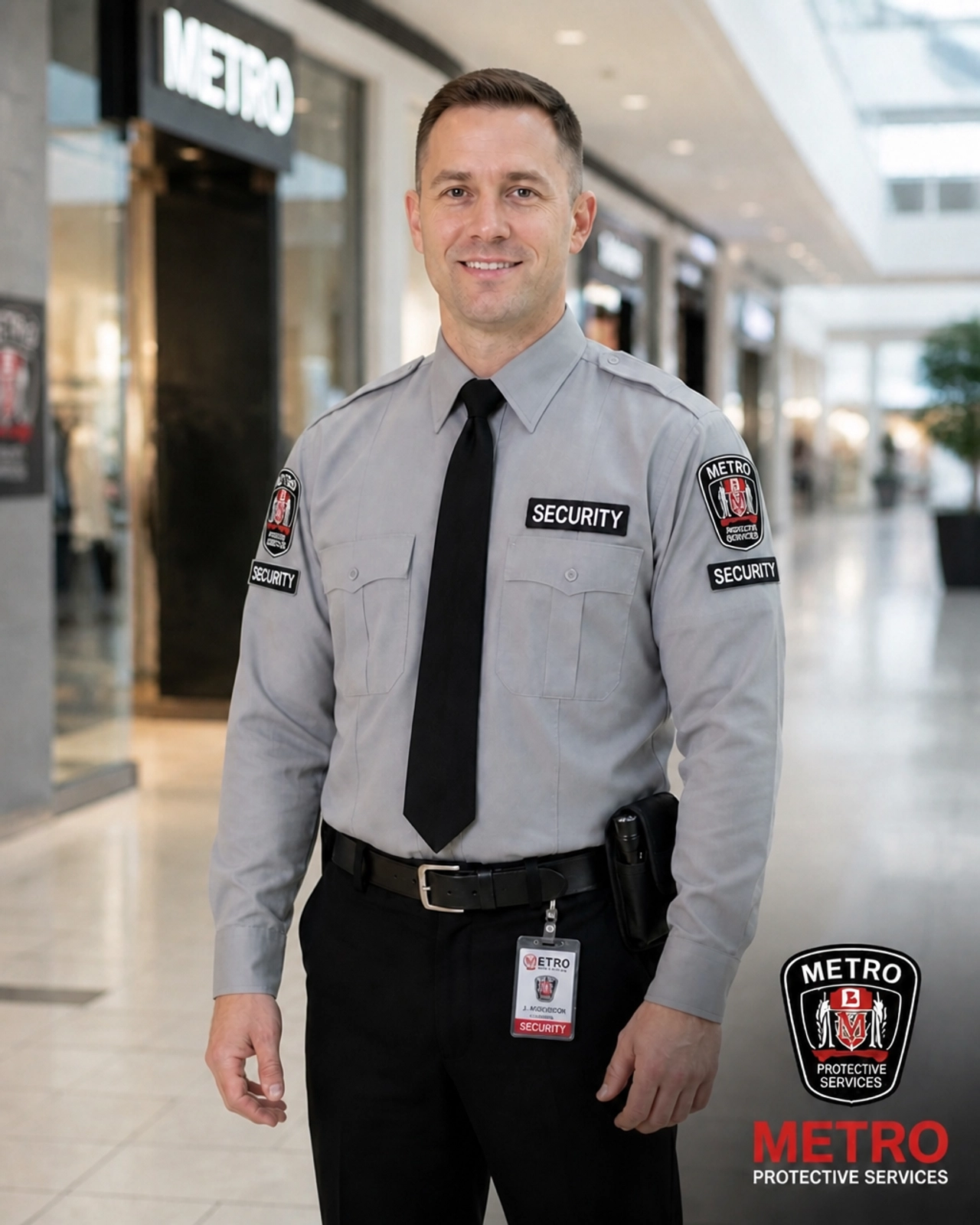
A uniformed guard presence can help reinforce site instructions by making access points and patrol activity visible. The value depends on a clear assignment: the post orders should identify priority areas, reporting contacts, patrol expectations and what constitutes an incident or exception. Metro’s retail and commercial security and loss prevention services can be tailored to a property’s operating needs. More broadly, security guard services Toronto businesses use can include scheduled coverage and dispatch coordination.
Documentation supports management review after a shift or incident. Metro’s 24/7 dispatch centre coordinates assignments, while the Sky-Guard Monitoring System supports GPS check-ins and electronic reporting. Daily reports can record observations, access concerns, patrol activity and escalations, subject to the agreed scope and site instructions. Body cameras may also be used where deployed and where permitted by the applicable policy. These tools support accountability and review; they do not replace store controls or guarantee a particular outcome.

A report is most useful when it is specific and consistent: what was observed, where and when it occurred, who was notified, and what follow-up was requested. Managers can use this record to compare incidents with internal logs and decide whether procedures or staffing arrangements need adjustment.
For retail plazas, strip centres and standalone stores where a fixed post is not required through every hour, mobile patrol services Toronto businesses use can provide scheduled exterior checks of loading zones, service corridors and parking areas, with check-ins recorded through the Sky-Guard Monitoring System.
Visible coverage should remain focused on observation, communication and documentation. Guards should not be directed to confront staff or customers based on suspicion. When a safety issue arises, the guard should follow post orders, contact the designated manager or dispatch centre, and call police when appropriate.

A Practical Holiday Checklist for Store and Property Managers
Before holiday operations intensify, managers can review the following items with their internal teams and security provider:
- Confirm which roles can enter stockrooms, receiving areas, cash offices and other restricted spaces.
- Review procedures for issuing, changing and deactivating keys, cards and system permissions.
- Ensure seasonal staff receive site orientation and know their supervisors and reporting channels.
- Reconfirm who approves refunds, voids, discounts and overrides, and how exceptions are documented.
- Check that cash counting, deposit preparation, secure storage and handoffs follow written store procedures.
- Review vendor and contractor authorisation, visitor logging, delivery access and work-hour expectations.
- Update guard post orders with priority locations, patrol instructions, escalation contacts and reporting requirements.
- Agree on how daily electronic reports will be reviewed and who is responsible for follow-up.
- Coordinate retail operations with any renovation, shared loading area or mixed-use property security plan.
The goal is not a separate plan for one shopping day. It is a check that routine controls remain workable as staffing and receiving volumes rise. The RCC report’s findings underline the importance of consistent records: shrink is not a uniform measure, and documented incidents can help management distinguish theft concerns from process errors and other operational losses.
Need Help? Chat with Us
If you are reviewing retail coverage or back-of-house procedures for the holiday season, Metro Protective Services can help you discuss a plan suited to your site and operating hours. Request a security quote, message our team on WhatsApp, or visit our careers page to learn about joining our team.
Recent Posts
- Concierge Security Services That Guard Toronto Lobbies After Dark This Winter
- Mobile Patrol Services Toronto Property Managers Trust When the Alarm Sounds This Winter
Tags: Retail Loss Prevention, Security Guard Services Toronto, Commercial Security, Residential Security Toronto, Construction Site Security Services, Mobile Patrol Services Toronto, Concierge Security Services, Employee Theft Prevention, Sky-Guard Monitoring System, GTA Property Protection

