

-
info@Metroprotective.ca
Send Email
-
Toronto – Hamilton – London – Windsor
Metro Protective Services
Tel: 416-240-0911
Confidentiality Guaranteed
Tel: 416-240-0911
Confidentiality Guaranteed
15
Oct
Oct
Comprehensive Security Guard and Property Protection Services in Toronto and the GTA: Retail Loss Prevention That Prepares GTA Stores, Staff, and Margins for the Holiday Shopping Rush
Home / Blog / Retail Loss Prevention
Published: October 14, 2026
Series: Comprehensive Security Guard and Property Protection Services in Toronto and the GTA, Entry 16
Category: Retail Loss Prevention
For Toronto and GTA retailers, mid-October is a useful window to prepare for the holiday rush. Stores are receiving seasonal inventory, hiring temporary staff, extending operating hours and planning promotions. These changes can create more opportunities for theft and operational disruption just as customer traffic increases.
Preparation does not mean treating every customer as a risk. It means reviewing the store’s vulnerabilities, making sure staff know how to respond, and arranging professional coverage where it can make a practical difference. A coordinated retail loss prevention plan can support safer stores, protect inventory and help managers make informed decisions during the busiest weeks of the year.
Why prepare before holiday traffic builds?
The holiday season places extra demands on store teams. Employees may be balancing customer service, replenishment, returns, click-and-collect orders and busy checkout areas. New staff may not yet know the store layout, reporting procedures or whom to contact when an incident occurs.
National data also underscore the value of planning. Statistics Canada reported that police-reported shoplifting under $5,000 reached 208,941 incidents in 2025, an increase of 11% over the previous year. The Retail Council of Canada’s retail crime research also describes the growing operational and safety impacts associated with retail crime. These figures are not a prediction for any individual store, but they reinforce why retailers should review their procedures before peak trading begins.
Organized retail crime can involve coordinated activity across locations, repeat visits or attempts to take high-value, easily resold goods. For a GTA retailer, a loss prevention plan should therefore address more than merchandise. Employee and customer safety, incident documentation and timely communication are equally important.
Start with a practical seasonal risk review
A useful review looks at the store as it will operate in November and December, not only as it operates today. Consider changes to opening and closing hours, staffing levels, delivery schedules, product placement, promotional displays and expected foot traffic.
Walk the premises with store leadership and identify areas that may need added attention:
- High-value or frequently targeted merchandise
- Checkout and self-checkout zones
- Returns desks and online order collection points
- Stockrooms, receiving doors and delivery areas
- Entrances, exits and areas with obstructed sightlines
- Staff entrances, parking areas and closing routes
- Times when temporary staffing or customer volume is highest
Use incident records, inventory information and employee feedback to prioritize locations and time periods. A focused plan may call for extra coverage near specific departments during busy evening hours, rather than the same level of coverage everywhere.

Prepare seasonal staff to report concerns safely
Seasonal employees should receive a clear, concise orientation before working on the sales floor. Explain who to contact, how to report a concern, what information to share and what actions are outside their role. They should know how to request help discreetly and how to respond if a customer or colleague feels threatened.
A consistent reporting process can cover:
- The time and location of the incident
- A factual description of observed behaviour
- Merchandise or property involved, if known
- Whether a threat, injury or damage occurred
- Who was notified and what follow-up is needed
Employees should not be encouraged to pursue or physically confront someone over merchandise. A safety-first approach is essential. Any intervention must follow company procedures, applicable law and the individual’s training and authorization. When a situation escalates or there is an immediate threat, staff should follow emergency procedures and contact emergency services as appropriate.
Match professional security coverage to the store’s needs
Professional security guard services in Toronto can provide a visible, service-oriented presence in stores, shopping centres and commercial properties. Guards can support observation, access procedures, incident response and communication with management, while helping customers feel welcome. Their post orders should be specific to the site: priorities, escalation contacts, reporting expectations and boundaries should be established before the shift begins.
Metro Protective Services has served Toronto and the GTA since 2000. Our retail and loss prevention services are designed around each client’s property, operating schedule and identified risks. Coverage may include uniformed security personnel, retail patrol, incident documentation and coordination with store leadership.

Stores in malls or open-air plazas may also benefit from coordinating with property management and neighbouring tenants. Shared procedures for reporting incidents, managing closing periods and communicating urgent safety concerns can help teams respond consistently across a larger site.
Extend protection beyond the sales floor
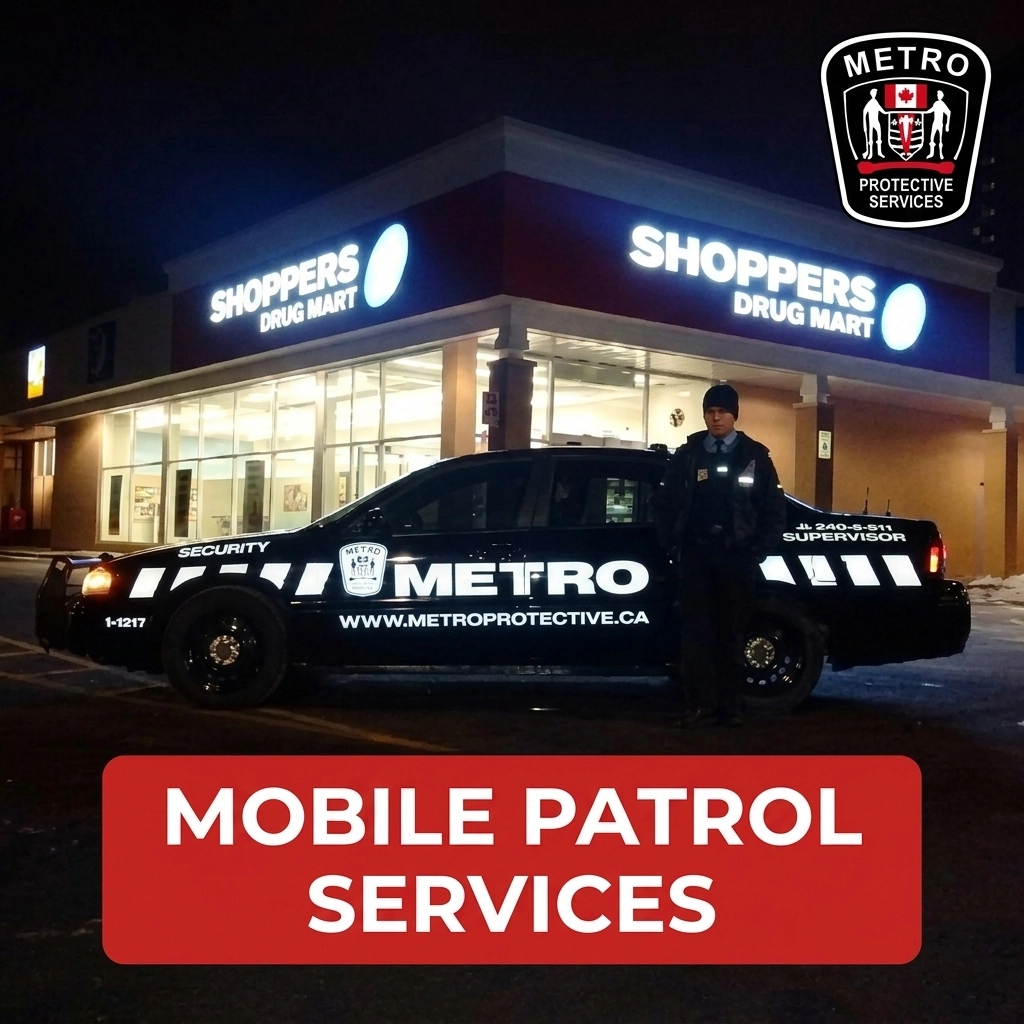
Retail security needs can continue after the doors close. Stock deliveries, late shifts, parking areas and exterior entrances may create security concerns outside normal shopping hours. Mobile patrol services in Toronto can add checks to a broader property plan, including inspections of parking areas, delivery access points and building perimeters.
Patrol frequency and routes should reflect the property’s layout and operating schedule. For a mall, that could mean checking entrances and loading areas after closing. For a retail plaza, it could include exterior checks during late-night hours. Metro’s mobile patrol services can complement on-site guards where a property needs coverage across multiple locations.
Metro Protective Services’ 24/7 dispatch centre supports communication and coordination when an incident, alarm or urgent request arises. The Sky-Guard Monitoring System uses GPS check-ins and electronic reporting to document patrol activity and site events. Daily electronic reports give clients a record to review, follow up on and use when evaluating their security plan.

Coordinate retail and residential security at mixed-use properties
Some GTA retail locations are part of mixed-use developments with residential towers, shared entrances or connected parking areas. In these settings, retail security and residential protection should work together without blurring their separate responsibilities. Property managers can coordinate incident communication, access procedures and after-hours expectations between commercial tenants and residential management.
Professional concierge and lobby security services can support residential buildings by assisting with visitor procedures, monitoring designated entry points and communicating building concerns through established protocols. Learn more about Metro’s concierge services.
Where a property is near a shelter, rehabilitation facility or supervised consumption site, planning should be based on documented site conditions and specific behaviour, not assumptions about people who use nearby services. Clear reporting standards, well-maintained lighting and access points, and respectful de-escalation procedures can help protect staff, residents, customers and visitors. Property teams can also identify appropriate community or emergency contacts in advance.
Use reports to improve the plan through the season
A security plan should be reviewed as conditions change. Managers can look at incident patterns, coverage gaps, recurring safety concerns, response times and whether reports contain enough detail to guide follow-up. Seasonal events, promotions and changes to store hours may require adjustments to post orders or patrol schedules.
Sky-Guard GPS check-ins and daily electronic reports help provide visibility into completed patrols and documented site activity. This information supports practical discussions between the retailer, property manager and security provider. It can also help identify whether a concern is isolated or recurring across a store, time period or area of the property.
For more guidance, see Metro’s loss prevention services and retail and commercial security services. Statistics Canada’s police-reported crime statistics provide additional national context for retailers reviewing their seasonal plans.
A calmer holiday season begins with early preparation
Retailers do not need to wait for peak crowds to identify gaps. Reviewing store procedures in October gives managers time to onboard seasonal staff, clarify escalation steps, arrange appropriate security guard coverage and coordinate with property teams. A plan that combines trained people, clear communication and useful electronic reporting can help retailers manage risks while maintaining a professional customer experience.
Metro Protective Services provides security guard services, retail loss prevention, mobile patrol and concierge support across Toronto and the GTA. Our team has supported local businesses and properties since 2000, with 24/7 dispatch coordination and Sky-Guard reporting.
Recent Posts
- Parking Enforcement and Perimeter Security: A Blueprint for Securing GTA Rental Properties
- Mobile Patrol for Shopping Centres and Retail Plazas
- How to Choose the Best Loss Prevention Services in Toronto
Tags: Retail Loss Prevention, Retail Security Toronto, Security Guard Services Toronto, Mobile Patrol Services Toronto, Holiday Shopping Security, GTA Property Protection, Sky-Guard Monitoring System
Need help planning seasonal coverage? Contact Metro Protective Services to discuss a security plan for your store or property. Need help now? Chat with us.

