

-
info@Metroprotective.ca
Send Email
-
Toronto – Hamilton – London – Windsor
Metro Protective Services
Tel: 416-240-0911
Confidentiality Guaranteed
Tel: 416-240-0911
Confidentiality Guaranteed
02
Oct
Oct
Comprehensive Security Guard and Property Protection Services in Toronto and the GTA: Retail Loss Prevention That Protects GTA Stores, Staff, and High-Value Inventory Through the Pre-Holiday Stock-Up
Breadcrumb: Home > Blog > Retail and Commercial Security > Retail Loss Prevention
Published: October 2, 2026
As Halloween approaches and retailers begin receiving larger volumes of seasonal and holiday inventory, stores across Toronto and the GTA face a more demanding security environment. Increased foot traffic, crowded sales floors, high-value merchandise, organized retail crime, and grab-and-run incidents can create pressure for store teams already focused on customer service and daily operations.
For retail operators, loss prevention is not limited to recovering stolen merchandise. A complete program must also protect employees, customers, delivery areas, fitting rooms, entrances, exits, and the wider property. This is particularly important for stores located in busy plazas, shopping centres, malls, big-box developments, grocery stores, and pharmacies.
Metro Protective Services provides coordinated retail security and loss prevention services designed around each property’s operating hours, layout, risk profile, and seasonal demands.
Why the pre-holiday stock-up period requires additional planning
The weeks before Halloween and the broader holiday shopping season often bring more customers, longer operating hours, promotional events, and significant inventory deliveries. These conditions can make it more difficult for store employees to identify suspicious behaviour or respond consistently to incidents.
Common risks during this period include:
- Grab-and-run attempts near entrances and exits
- Organized groups working together to distract staff or remove merchandise
- Theft of electronics, cosmetics, gift cards, alcohol, pharmacy products, and other high-value items
- Increased concealment opportunities created by crowded aisles, costumes, bags, and bulky outerwear
- Confrontations involving customers, suspected offenders, or unauthorized individuals
- Safety concerns for employees opening or closing the store
- Theft or damage affecting loading areas, exterior storage, and parking lots
A seasonal protection plan should be established before inventory arrives. It should identify high-risk time periods, review previous incident reports, assess staffing levels, and define how store personnel will request assistance.
Retail loss prevention should protect people as well as inventory
The primary objective of retail security is not to encourage employees to physically confront suspected offenders. Staff safety must remain the first priority. Store employees should know how to report suspicious conduct, contact management or security, preserve relevant information, and respond to incidents without unnecessarily escalating the situation.
A trained loss prevention guard can provide a professional point of contact for employees and customers while observing activity throughout the store. Depending on the site, coverage may include:
- Visible security at the main entrance or exit
- Floor patrols through high-value departments
- Observation of fitting rooms and adjacent corridors
- Support near self-checkout and cash areas
- Monitoring of customer queues during peak periods
- Assistance with disruptive behaviour and de-escalation
- Coordination with store management and emergency services when required
- Detailed documentation of incidents, safety concerns, and follow-up actions
A uniformed presence can also deter opportunistic theft before it begins. In larger stores or locations with recurring shrinkage, a tailored combination of visible security and discreet loss prevention coverage may provide stronger results than relying on employees alone.

Coverage planning for plazas, malls, big-box stores, and pharmacies
Retail security requirements vary significantly by property type. A standalone pharmacy may need close attention to entrances, high-value products, and late-night activity. A grocery store may require coverage around self-checkout, cash offices, loading docks, and parking areas. A big-box store may need a broader patrol plan involving several departments, exterior doors, receiving areas, and large parking lots.
For shopping malls and multi-tenant plazas, security planning must also consider shared spaces. Parking lots, walkways, rear service corridors, garbage enclosures, and loading zones can affect the safety of several businesses at once.
A practical deployment plan should consider:
-
Operating hours and peak traffic
Coverage should reflect opening, closing, evening shopping, weekends, promotional events, and Halloween-related activity. -
Store layout and visibility
Guards should understand blind spots, fitting-room access, emergency exits, cash areas, and the location of high-value inventory. -
Delivery and receiving schedules
Larger pre-holiday shipments may create additional activity around loading docks and back-of-house areas. -
Employee arrival and departure
Opening and closing teams may require support when doors are unlocked, tills are transported, or staff leave after dark. -
Shared property risks
Security plans should account for parking areas, neighbouring tenants, construction activity, and residential buildings within the same development.
For property managers overseeing mixed-use sites, retail coverage can be coordinated with residential concierge and lobby security services. This helps maintain consistent communication between commercial tenants, building management, and residential operations.
How mobile patrol services extend protection after closing
Static retail guards provide an important on-site presence during operating hours. However, many incidents occur after stores close, when employees have left and storefronts, loading areas, and parking lots become less active.
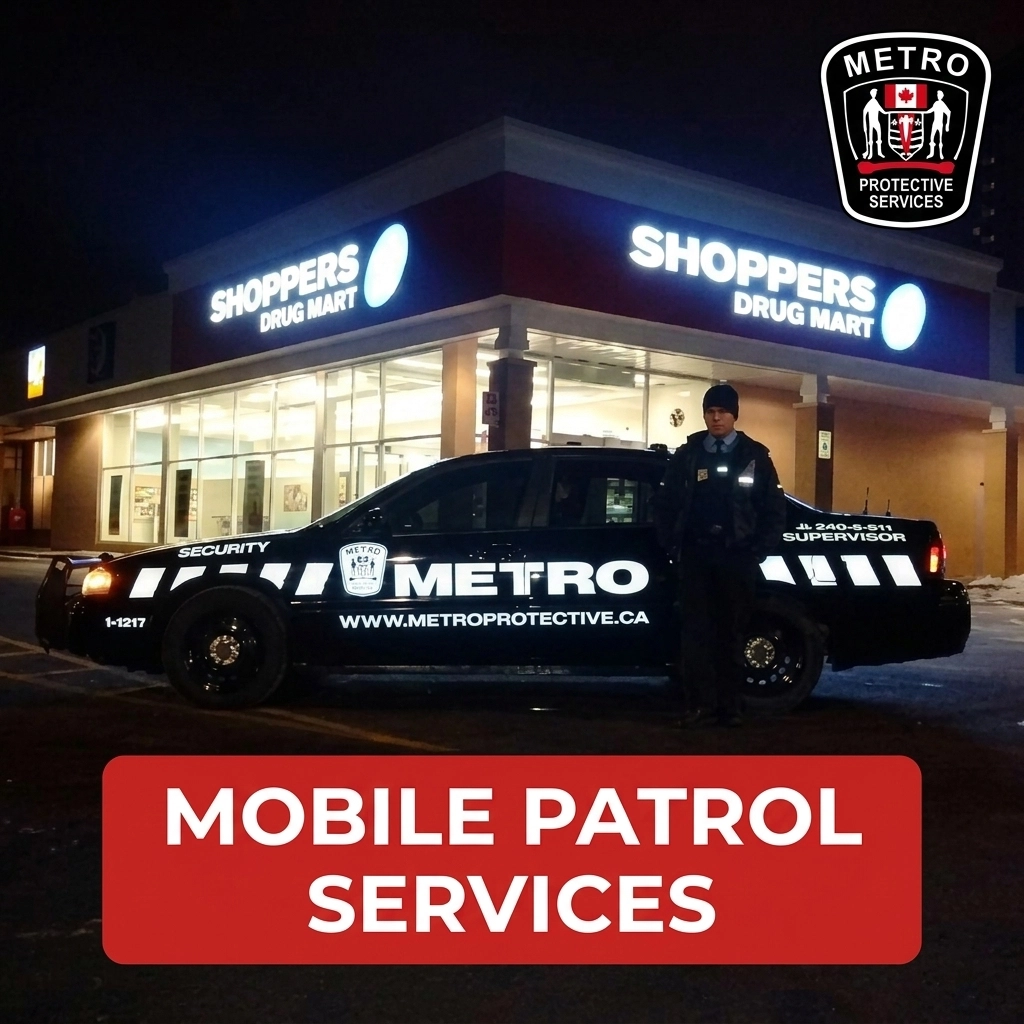
Mobile patrol services Toronto businesses use can extend coverage through scheduled or randomized after-hours inspections. Metro Protective Services mobile patrol officers can check:
- Storefront doors and rear access points
- Loading docks and receiving areas
- Parking lots and pedestrian walkways
- Exterior storage and waste areas
- Gates, service corridors, and common property spaces
- Signs of forced entry, vandalism, loitering, or property damage
A marked Metro vehicle creates a visible deterrent while allowing one patrol unit to support multiple retail locations across a plaza or portfolio. Patrol frequency can be adjusted for Halloween events, inventory deliveries, known incident patterns, or temporary increases in risk.

Sky-Guard provides documented accountability
A security program should give property managers more than a verbal assurance that a site was checked. Metro Protective Services uses the Sky-Guard Monitoring System to support GPS check-ins, patrol verification, and electronic reporting.
During a patrol or security shift, relevant activity can be documented electronically with time, location, incident details, and photographs where appropriate. Daily electronic reports help retail operators identify recurring concerns and make informed decisions about coverage.
For example, reports may help reveal:
- Repeated activity near a particular entrance
- Unsecured doors or gates after closing
- Lighting failures in parking or loading areas
- Recurring incidents during a specific day or time
- Damage that requires maintenance attention
- Gaps between scheduled deliveries and available supervision
This information can be shared with store leadership, property managers, loss prevention teams, and other authorized stakeholders. It also supports a more accountable relationship between the security provider and the client.
A coordinated approach to GTA property protection
Retail stores are often part of broader commercial properties. A shopping centre may include restaurants, pharmacies, financial institutions, residential towers, and active construction areas. When multiple risks exist on the same site, a provider with experience across different environments can help coordinate the overall security plan.
Metro Protective Services has served Toronto and the GTA since 2000. Our services include trained security guards, retail loss prevention, mobile patrol, parking enforcement, concierge protection, industrial security, and 24/7 dispatch centre coordination.
This broader operational experience is useful when retail properties are adjacent to redevelopment or active construction. For example, a plaza undergoing expansion may require both retail coverage and construction site security services to protect equipment, materials, access points, and tenant operations.
Our approach combines professional personnel, visible deterrence, responsive dispatch support, Sky-Guard monitoring, daily electronic reporting, and competitive pricing. Coverage can be designed for a single storefront, a shopping plaza, a grocery or pharmacy location, a large retail portfolio, or a mixed-use property.
Review your holiday security plan before inventory arrives
Retailers do not need to wait for a serious incident before reviewing their security arrangements. Before the pre-holiday stock-up period becomes busy, property managers and store operators should confirm:
- Which areas require additional guard coverage
- Whether employees understand incident reporting procedures
- Whether fitting rooms, entrances, exits, and loading areas are properly monitored
- Whether exterior lighting and cameras are functioning
- How after-hours mobile patrol checks will be scheduled
- How management will receive electronic reports
- Who will coordinate emergency response through the 24/7 dispatch centre
- Whether existing coverage can scale during Halloween and holiday peaks
The right plan should be practical, measurable, and tailored to the individual property rather than based on a standard schedule.
Request a no-obligation retail security assessment
Metro Protective Services can review your store, plaza, mall, pharmacy, grocery location, or multi-site retail portfolio and recommend a protection plan based on your operating hours, inventory profile, past incidents, property layout, and budget.
Since 2000, our team has helped businesses across Toronto and the GTA combine trained security guards, retail loss prevention, mobile patrol, 24/7 dispatch coordination, and electronic reporting into one accountable service.
Contact Metro Protective Services for a no-obligation site assessment.
Need Help? Chat with us
Request a Quote: Submit now
Phone: 416-240-0911
Email: info@metroprotective.ca

Category Tags
#RetailLossPrevention #TorontoSecurity #GTASecurity #MobilePatrol #RetailSecurity #PropertyProtection #SkyGuard #MetroProtectiveServices
Recent Posts
- How to Choose the Best Security Guard Services Toronto Compared
- Mobile Patrol and Parking Enforcement That Protect GTA Properties After Hours
- The Ultimate Guide to Security Guard Services Toronto


