

-
info@Metroprotective.ca
Send Email
-
Toronto – Hamilton – London – Windsor
Metro Protective Services
Tel: 416-240-0911
Confidentiality Guaranteed
Tel: 416-240-0911
Confidentiality Guaranteed
07
Sep
Sep
Security Cameras and Mall Guards: Designing a Strong Human-and-Technology Partnership
Breadcrumbs: Home > Blog > Mall Security > CCTV and Security Guards
Published: August 29, 2026
Category: Mall Security
Tags: Mall Security Toronto, CCTV Monitoring, Security Guard Services Toronto, Commercial Security Services GTA, Retail Security, Incident Reporting
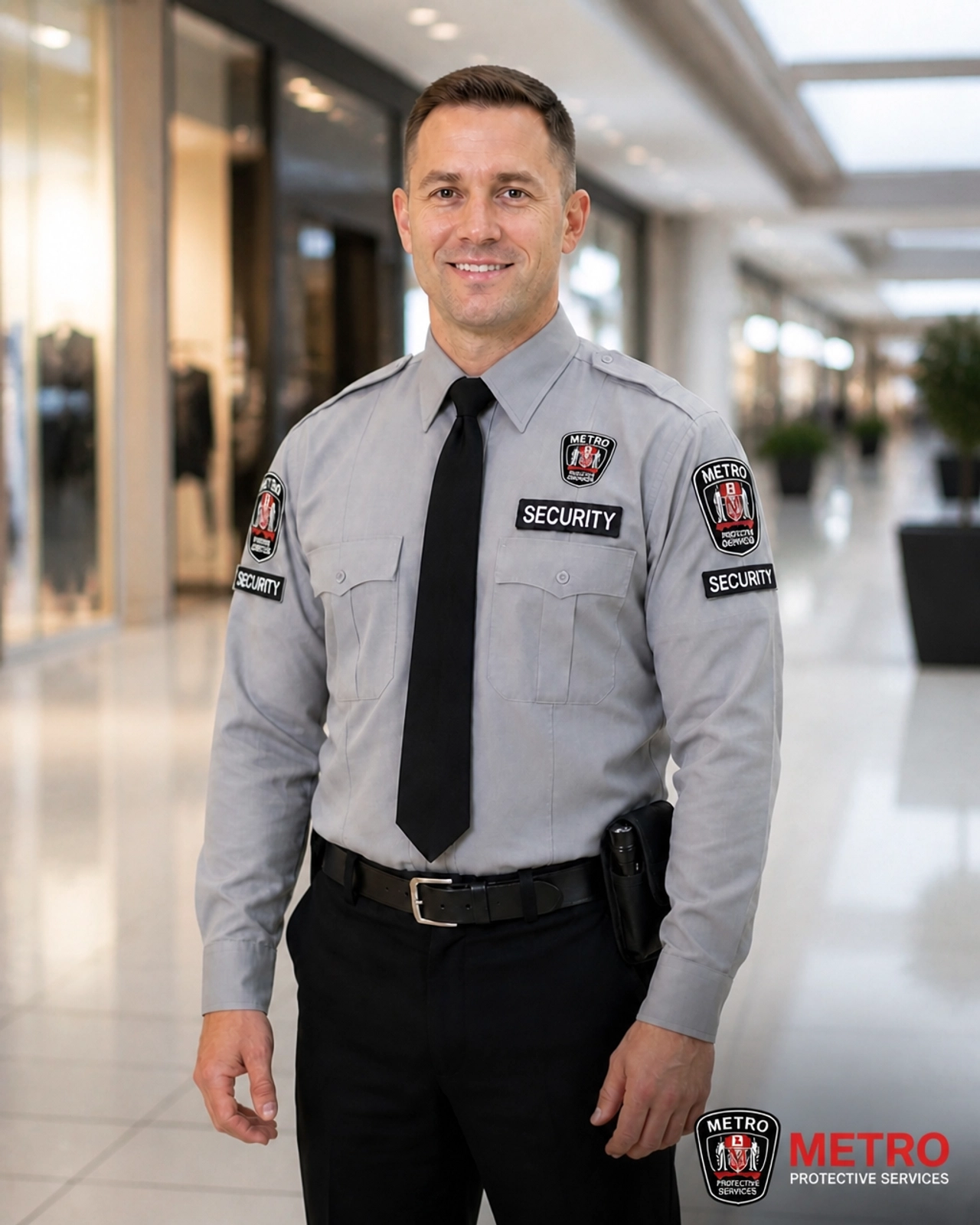
Shopping malls require more than visible patrols or a network of security cameras operating independently. A dependable protection program combines trained security guards, CCTV operators, access-control systems, alarms, lighting, electronic reporting, and responsive dispatch coordination.
Technology can extend the field of view and provide valuable information. It can identify an alarm, show activity in a parking area, or help reconstruct an incident. It cannot replace the judgment, communication skills, situational awareness, and physical presence of a trained security professional.
For property managers and mall operators evaluating mall security Toronto solutions, the objective should be a coordinated human-and-technology partnership. Each component must support the others through clear procedures, defined responsibilities, and regular review.
Why cameras alone are not enough
CCTV systems are valuable because they provide broad coverage across entrances, corridors, food courts, parking areas, loading docks, and other high-traffic locations. They can help deter misconduct, support real-time awareness, and preserve evidence for later review.
However, cameras have practical limitations:
- A camera may be obstructed, misaligned, damaged, or affected by glare.
- A single view may not show where a person came from or where they went.
- Crowds, displays, columns, seasonal decorations, and parked vehicles can create blind spots.
- Video may show activity without explaining the circumstances behind it.
- An alarm or analytics alert may be triggered by an innocent event.
- Operators cannot physically assist a visitor, separate people, secure a location, or provide first aid.
A security guard provides the human layer that technology cannot. Guards can assess changing conditions, speak with tenants and visitors, identify hazards, apply post orders, and coordinate an appropriate response. The strongest programs use CCTV to help guards make better decisions rather than treating a camera feed as a substitute for on-site personnel.
Build a clear CCTV-to-guard response process
The response process should be written into site-specific procedures and reviewed with both the control-room team and on-site guards. A practical workflow includes five stages.
1. Observe
The CCTV operator identifies the location, time, and nature of the event. The operator should describe observable facts rather than assumptions. For example, “a person has entered the closed service corridor” is more useful than assigning an unverified motive.
2. Verify
Before dispatching a guard, the operator should check nearby camera views where available. This may establish:
- The person’s direction of travel
- Whether another person is involved
- Whether an access-controlled door was opened
- Whether there is an immediate safety concern
- Whether the alert is caused by a maintenance issue, authorized activity, or environmental condition
Verification does not mean delaying a response to an emergency. If there is a credible indication of violence, fire, a medical emergency, a weapon, or an active intrusion, the appropriate emergency response should begin immediately.
3. Communicate
The CCTV operator or dispatcher should provide concise information over the designated communication channel:
- Exact location
- Description of the activity
- Number of people involved
- Direction of travel
- Relevant camera or access point
- Whether the situation is ongoing
- Whether police, fire, or medical services have been contacted
Clear communication allows guards to approach safely and reduces the risk of several team members responding without a shared understanding of the situation.
4. Respond
The guard follows site post orders and applicable law, while maintaining a focus on safety, de-escalation, and professional conduct. Depending on the situation, the response may involve a welfare check, tenant assistance, a patrol of the area, access restriction, preservation of a scene, or escalation to emergency services.
A camera-based alert should not automatically lead to a confrontation. Trained judgment remains essential, particularly where the facts are incomplete or the situation involves a vulnerable person, a customer complaint, or a misunderstanding.
5. Confirm and document
After the response, the guard communicates the outcome to dispatch or the control room. The CCTV operator preserves relevant information according to the property’s procedures, and the incident is documented through authorized electronic reporting and communication systems.

Address camera blind spots as an operational issue
Camera placement should be reviewed from the perspective of both the technology team and the guards who work in the property every day. A floor plan may suggest complete coverage while operational experience reveals areas that are difficult to monitor.
Common blind-spot locations include:
- Behind temporary retail displays
- Between parking structures and mall entrances
- Service corridors and delivery routes
- Stairwells and elevator lobbies
- Washroom approaches and secluded seating areas
- Loading docks and waste-management areas
- Outdoor walkways affected by snow, darkness, or glare
- Areas where cameras overlap poorly or lose a subject between views
Guards should be encouraged to report recurring coverage gaps, damaged equipment, poor lighting, and changes to the physical layout. Supervisors can compare those observations with incident reports and video review to recommend camera repositioning, additional lighting, revised patrol routes, or temporary measures during construction and special events.
The most effective mall security plans do not treat the original camera map as permanent. Retail layouts, tenant operations, parking patterns, and public behaviour change over time.
Connect access control, alarms, and lighting
CCTV is most useful when it is considered alongside other site systems.
Access control
Card readers, electronic locks, and credential systems can restrict access to loading areas, management offices, mechanical rooms, staff corridors, and other sensitive locations. When an access event can be reviewed alongside nearby video, the security team gains a clearer picture of what occurred.
Guards should also understand what to do when:
- An access card is denied repeatedly
- A door is propped open
- A restricted door is held for an unknown person
- A tenant reports a lost credential
- A delivery arrives outside the approved schedule
Alarms and emergency signals
Duress buttons, intrusion alarms, door contacts, fire-system notifications, and elevator emergency calls should have defined response procedures. The guard should know whether the first action is to attend the location, contact building operations, notify dispatch, protect a scene, or request emergency services.
Alarm response is more reliable when the control room can provide context from nearby cameras without assuming that every activation represents the same level of risk.
Lighting
Good lighting supports both camera performance and human observation. Mall operators should review illumination around entrances, parking areas, ramps, stairwells, loading zones, and exterior walkways. Glare, deep shadows, damaged fixtures, and seasonal changes can reduce the effectiveness of otherwise capable equipment.
A guard’s report about poor visibility may be the first indication that a lighting adjustment is required.
Use privacy-conscious surveillance procedures
Mall surveillance must support safety while respecting privacy and the public nature of the environment. Property managers should establish written rules for camera access, video review, exports, retention, and information sharing.
Important safeguards include:
- Posting clear notices that video surveillance is in use and stating its general security purpose
- Limiting viewing and export permissions to authorized personnel
- Maintaining an audit trail for video access and exports
- Avoiding unnecessary monitoring of private or sensitive activities
- Prohibiting casual viewing or sharing of footage
- Retaining footage only for an established business, investigative, insurance, or legal purpose
- Preserving original footage securely when it relates to an active incident
- Using appropriate redaction before footage is shared outside authorized investigative channels
Guards and CCTV operators should also receive instruction on respectful, objective observation. Decisions should be based on conduct, credible information, and established procedures: not on protected characteristics, appearance, or unsupported assumptions.
Make documentation useful for supervisors and clients
Incident documentation should allow a property manager to understand what happened, what actions were taken, and what follow-up may be required. A complete report should generally include:
- Date, time, and exact location
- Names or identifiers of responding personnel
- Objective description of the event
- Relevant camera locations or alarm points
- Access-control information, where applicable
- Actions taken by guards, dispatch, management, or emergency services
- Witness or tenant information, where appropriate
- Outcome and outstanding follow-up
- Any equipment, lighting, or procedural issue identified
Electronic reporting helps create a consistent record, but report quality still depends on training and supervision. A supervisor should review significant incidents for completeness, clarity, policy compliance, and recurring patterns. That review can identify whether a post order needs to change, whether a tenant requires additional support, or whether a technical system produced repeated false alerts.
Metro Protective Services has served Toronto and the GTA since 2000, providing trained personnel for retail and commercial properties. Our guards work with existing security systems, while our 24/7 dispatch centre coordinates responses, mobile supervisors, patrol requirements, and client communication. Daily electronic reports and supervisor oversight help property managers assess the service delivered and identify operational concerns.
Mall security technology-and-guard checklist
Before approving or revising a mall protection plan, confirm that the program includes:
- A current camera and access-control map
- Documented blind spots and temporary coverage measures
- Defined CCTV verification and dispatch procedures
- Clear emergency escalation criteria
- Radio and communication protocols
- Routine checks for cameras, alarms, access points, and lighting
- Privacy, retention, and video-export procedures
- Consistent electronic incident reporting
- Supervisor review of significant incidents
- Regular meetings with property management and key tenants
- Patrol routes adjusted for peak periods, events, and changing risks
A coordinated approach protects people, property, and operations
A mall’s security technology should make trained guards more informed, more responsive, and more effective. Cameras can extend visibility. Access control can establish accountability. Alarms can identify abnormal conditions. Lighting can improve detection. Dispatch can coordinate resources.
The guard remains responsible for applying judgment in the real environment.
For decision-makers seeking security guard services Toronto or integrated commercial security services GTA, the right question is not whether to choose people or technology. It is how to design procedures that allow both to work together consistently, professionally, and with respect for the people who visit, work in, and manage the property.
Need Help? Chat with us or contact Metro Protective Services to discuss a mall security plan for your property.
Recent Posts
- How to Choose the Best Loss Prevention Services in Toronto
- Securing the Scene: A Guard’s Protocol for Discovering a Crime Scene
- Retail and Commercial Security Services
- Explore Metro Protective Services


