

-
info@Metroprotective.ca
Send Email
-
Toronto – Hamilton – London – Windsor
Metro Protective Services
Tel: 416-240-0911
Confidentiality Guaranteed
Tel: 416-240-0911
Confidentiality Guaranteed
11
Sep
Sep
Mobile Patrol for Shopping Centres and Retail Plazas: Extending Mall Security Coverage
Breadcrumbs: Home / Blog / Mall Security
Published: August 29, 2026
Category: Mall Security
Tags: Mall Security Toronto, Mobile Patrol Services Toronto, Retail Security, Retail Loss Prevention, Parking Lot Security, Property Protection
Shopping centres and retail plazas require security coverage that extends beyond the front entrance. A mall may include multiple buildings, large parking areas, perimeter roads, loading docks, vacant units, service corridors, and tenant spaces operating on different schedules. An open-air plaza can remain active long after individual stores close, while an enclosed shopping centre may have several access points requiring inspection overnight.
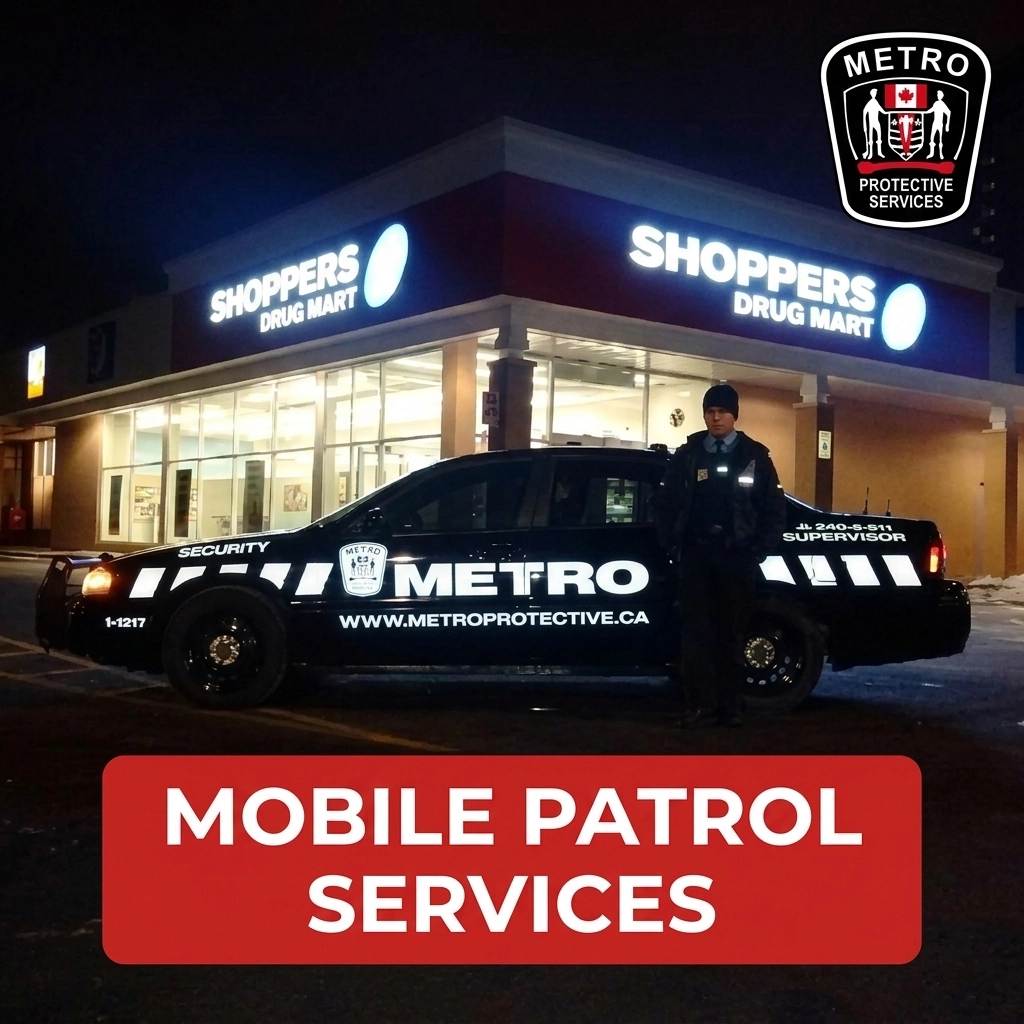
For property managers, mobile patrol provides a practical way to extend the reach of on-site security. Scheduled and randomized patrols create a visible deterrent, identify maintenance and safety concerns, support static mall guards, and provide a response resource when alarms or incidents occur.
Metro Protective Services has served Toronto and the GTA since 2000. Our mobile patrol teams work in coordination with a 24/7 dispatch centre, professional supervisors, and electronic reporting procedures designed to give property managers a clear record of patrol activity and incidents.
Why mobile patrol is valuable for mall and plaza properties
Static security guards provide an important on-site presence at entrances, customer service areas, loading docks, and other designated posts. However, a single guard cannot continuously monitor every parking aisle, perimeter road, vacant unit, and rear service area.
Mobile patrol helps close those coverage gaps. A marked patrol vehicle can move across the property at planned intervals while officers conduct targeted foot inspections in locations that cannot be effectively observed from a vehicle.
A well-designed mobile patrol program can help property managers:
- Increase visible security coverage during peak and after-hours periods
- Deter theft, vandalism, trespassing, and unauthorized access
- Monitor parking lots, garages, access roads, and loading areas
- Inspect vacant units and low-traffic sections of the property
- Respond to intrusion and security alarms
- Support mall security guards during incidents or high-volume periods
- Identify lighting, gate, door, camera, and maintenance concerns
- Maintain electronic patrol and incident records for management review
Mobile patrol is not a replacement for every static post. It is a flexible layer that strengthens the overall security plan.
Scheduled and randomized patrols
Patrol planning should balance consistency with unpredictability. Property managers need confidence that specific areas will be inspected, but patrols should not follow a pattern that can be easily anticipated.
Scheduled checks
Scheduled patrols are useful for known operational requirements, including:
- Opening checks before tenants or staff arrive
- Lock-up inspections after the final stores close
- Delivery and loading dock monitoring
- Parking-area checks during late-night closing periods
- Shift-change support for static mall guards
- Regular supervisor inspections
- Unlocking designated doors for authorized contractors or tenants
The schedule should identify the areas to be checked, the required frequency, access procedures, escalation contacts, and documentation standards.
Randomized checks
Randomized patrols vary the timing, route, and duration of inspections. A patrol officer may approach from a different access road, inspect a different parking sector first, or conduct a foot check at an unexpected time.
This approach is particularly valuable for:
- Large surface parking lots
- Multi-building retail properties
- Rear service lanes
- Vacant units
- Perimeter roads and fence lines
- Areas affected by repeated vandalism or trespassing
- Properties with overnight loading or construction activity
Randomization should not mean incomplete coverage. Each required area should still be included in the patrol plan and documented through electronic reports.

What a comprehensive exterior patrol should include
The patrol plan should be customized to the property layout and tenant schedule. A typical exterior inspection may include the following areas.
Parking lots and parking structures
Parking areas are central to the customer and employee experience, but they can also create security and liability concerns. Patrol officers can inspect:
- Driving lanes and parking aisles
- Isolated or poorly lit areas
- Accessible parking spaces and pedestrian routes
- Stairwells, elevators, and garage lobbies
- Fire routes and restricted parking zones
- Abandoned or damaged vehicles
- Signs of vandalism, vehicle break-ins, or property damage
- Obstructions affecting camera views or lighting
Officers can also report burned-out lights, damaged signage, open gates, blocked fire lanes, and other conditions requiring property management attention.
Perimeter roads and service areas
Perimeter roads and rear service areas often receive less public attention than storefronts. They should nevertheless be included in routine checks. Patrol officers can inspect:
- Rear building walls and access points
- Loading docks and receiving areas
- Garbage and recycling enclosures
- Fences, gates, bollards, and barriers
- Mechanical areas and exterior equipment
- Emergency exits and secondary doors
- Construction materials or storage areas
- Signs of forced entry or tampering
These checks are particularly important at multi-building properties where a problem in one section may not be visible from the main entrance.
Vacant units and closed storefronts
Vacant retail units can become targets for unauthorized entry, vandalism, dumping, or damage to mechanical systems. Patrol officers can confirm that designated doors and windows remain secure, look for broken glass or signs of tampering, and report conditions requiring immediate attention.
A vacant unit inspection should not involve entering the space unless the officer is authorized and the property’s procedures permit it. If forced entry is suspected, the officer should follow the established alarm and incident response protocol.
Lock-up, unlock, and opening support
Mobile patrol teams can assist with controlled opening and closing procedures when authorized by the property manager. This may include:
- Unlocking designated gates, doors, or access points
- Confirming that contractors or cleaning staff are authorized to enter
- Checking common areas before opening
- Verifying that tenants have completed lock-up procedures
- Confirming exterior doors and loading bays are secured
- Reporting doors that cannot be locked or that show signs of damage
Clear authorization lists and written post orders are essential. Officers should not unlock a location based solely on an informal request or an individual’s verbal claim. The process should identify approved contacts, access times, keys or credentials, and escalation instructions.
Alarm response and incident support
A mobile patrol unit can provide a rapid on-site response when an alarm is received through a monitoring service or reported by a tenant, employee, or static guard.
The response process should include:
- Dispatch coordination : The 24/7 dispatch centre communicates the alarm location, available information, and response instructions to the mobile unit.
- Safe arrival and assessment : The officer approaches carefully, observes the surrounding area, and identifies visible signs of forced entry, damage, fire, or other hazards.
- Verification : The officer checks the relevant exterior area or authorized interior location in accordance with the site’s procedures.
- Escalation : Police, fire, emergency medical services, property management, or building representatives are contacted when required.
- Area control : If a hazard or potential crime scene is identified, the officer protects the area and limits access until the appropriate response arrives.
- Documentation : Arrival time, alarm details, observations, actions, notifications, and outcome are recorded electronically.
Mobile patrol officers should not compromise their safety by entering an area where an active threat is suspected. The response plan must define when an officer observes from a safe position, withdraws, requests assistance, or waits for emergency services.

Supporting static mall security guards
Mobile patrol and static mall security are most effective when they operate as one coordinated team. A patrol officer can provide additional support when a static guard is managing:
- A disruptive person or customer complaint
- A suspected theft or retail loss prevention incident
- A medical emergency
- A parking dispute or vehicle-related concern
- A tenant lock-up issue
- A large event or seasonal shopping period
- A fire alarm or building evacuation
- A suspected break-in or property damage report
The mobile unit can also conduct supervisor inspections, deliver updated instructions, verify post orders, and provide relief or escort support when required. Dispatch coordination ensures that information is communicated between officers, supervisors, property management, and tenant representatives.
Electronic reporting for property management
A patrol program should produce more than a vehicle presence. Property managers need reliable records showing what was checked, when it was checked, and what was found.
Metro Protective Services uses electronic reporting procedures to document patrol activity, incidents, maintenance concerns, alarm responses, and supervisor inspections. Reports can include time-stamped observations, location details, photographs where appropriate, and follow-up recommendations.
This information helps property managers:
- Confirm that patrols were completed
- Identify recurring security or maintenance issues
- Track responses to tenant concerns
- Support insurance and incident documentation
- Review trends across parking areas and buildings
- Improve future patrol schedules and post orders
Mobile patrol planning checklist for shopping centres
Before implementing mobile patrol, property managers should confirm:
- The property map identifies every building, lot, access road, and restricted area.
- Patrol frequency is defined for operating hours, closing periods, and overnight coverage.
- Scheduled and randomized patrol requirements are documented.
- Parking lots, garages, loading docks, and perimeter roads are included.
- Vacant units and low-traffic areas have specific inspection instructions.
- Lock-up and unlock procedures identify authorized contacts.
- Alarm response instructions define escalation and emergency notification steps.
- Static mall guards and mobile patrol officers have clear communication procedures.
- Supervisor inspections are conducted at an appropriate frequency.
- Electronic reporting standards are established.
- Lighting, cameras, gates, doors, and other maintenance concerns are reported.
- Seasonal risks, construction activity, special events, and tenant schedules are reviewed.
A scalable approach for Toronto and GTA retail properties
Every shopping centre has a different risk profile. An enclosed mall may require interior common-area checks and coordinated closing procedures. An open-air plaza may need more frequent parking and perimeter patrols. A multi-building retail property may require a route plan that covers several entrances, rear service lanes, and vacant units.
Metro Protective Services develops mobile patrol programs around the property’s layout, operating schedule, tenant requirements, and incident history. Since 2000, our professional teams have supported retail and commercial clients across Toronto and the GTA with security guard services, mobile patrol, supervisor inspections, dispatch coordination, and retail loss prevention support.
Need help planning mall security coverage? Contact Metro Protective Services to discuss mobile patrol services Toronto property managers can implement across enclosed malls, retail plazas, and multi-building commercial properties.

